
God is ALL in All
This is a Philosophical and Spiritual endeavor to extract, Harmonize, and synthesize the Universal Truths underlying the world's Diverse Religious, Mystical, and Philosophical traditions. Most famously associated with the concept of Perennial Philosophy, it posits that All Major Traditions share a single, transcendent metaphysical Source and Core Set of Truths.
"By the Power of Truth, I, while Living, have Conquered the Universe."
"I Am Nothing, yet I Am Everything."
Unrighteousness — The Division Between Human Will and Divine Will
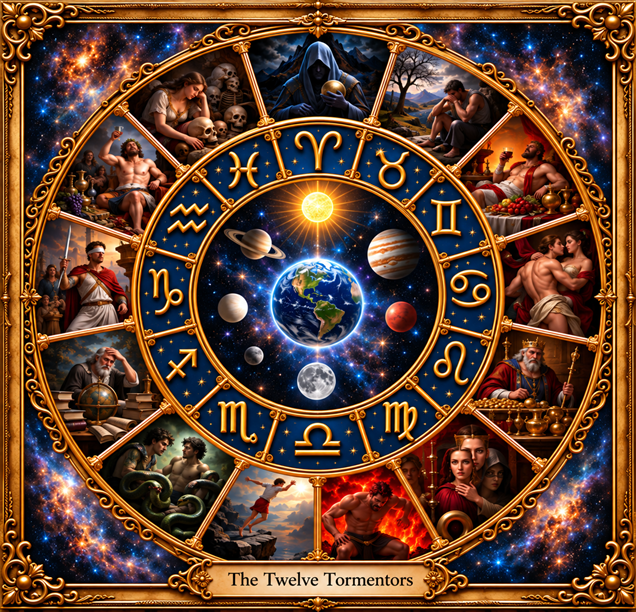
Continuing clockwise around the illustration, we encounter a man standing prominently before a group of people, his eyes covered by a white blindfold and a sword raised upright in his hand. He wears a white garment beneath a flowing red cloak, suggesting a figure possessing authority, responsibility, or the power to render judgment. Behind him, several individuals appear to be watching, perhaps awaiting a decision or witnessing the exercise of his authority. The scene immediately brings to Mind the traditional symbolism of Justice. Throughout Western artistic history, the blindfold and sword have frequently appeared as attributes of judicial authority. The blindfold commonly represents impartiality, indicating that justice should be administered without favoritism or prejudice, while the sword symbolizes the power to uphold the law and enforce judgment. Yet within this illustration of the Twelve Tormentors, these familiar symbols invite a different philosophical interpretation. Their presence encourages us to examine the relationship between outward authority, Inward Understanding, and the principles by which human judgment is exercised.
The blindfold may represent a condition in which Consciousness has become unable to perceive the Higher Spiritual Principles that should guide human judgment and conduct. The man possesses the authority to act, but his Spiritual Vision may be obscured by personal interests, pride, prejudice, or the limitations of earthly understanding. Although the blindfold traditionally symbolizes impartiality, within our interpretation it may also suggest the danger of exercising judgment without sufficient Spiritual Discernment. The sword introduces an equally important dimension. Although traditionally associated with justice, truth, discernment, and the authority to distinguish right from wrong, it may also symbolize division and separation. Within our interpretation, the raised sword represents the division that arises when the earthly ego places its own desires, judgments, and ambitions above the recognition of Divine Will. This division need not involve an outward act of violence. It may exist entirely within Consciousness, where personal inclination conflicts with the Higher Principles of Truth, Compassion, Justice, and the Good. The sword itself is not inherently destructive. Its meaning depends upon the Consciousness directing its use. A judgment made through prejudice may injure an innocent person, while an action motivated by pride may create unnecessary conflict. A decision made solely for personal advantage may deprive others of fairness, dignity, or opportunity. The consequences of Unrighteousness may therefore extend outward through families, communities, institutions, and entire societies.
In Corpus Hermeticum XIII, Unrighteousness is identified among the Twelve Tormentors associated with the Unregenerated human condition. It represents a condition contrary to the Divine Power of Righteousness, which emerges within the process of Spiritual Regeneration. Unrighteousness should not be understood merely as the violation of a particular civil law or religious commandment. Laws and customs differ among societies, and actions considered lawful within one historical period or culture may nevertheless raise profound questions of justice and morality. The deeper philosophical concern is the relationship between human conduct and the principles through which genuine righteousness may be recognized. An individual may possess considerable authority, occupy a respected position, or act in accordance with established institutions while nevertheless making decisions governed primarily by personal advantage, prejudice, or the desire to maintain power. Conversely, an individual without formal authority may demonstrate remarkable Righteousness through Honesty, Compassion, Fairness, and Concern for the Well-Being of Others.
Human authority is not necessarily Divine Authority, and the Exercise of Power is not necessarily the Exercise of Righteousness.
This distinction is especially significant when considering the people standing behind the blindfolded figure. Their presence reminds us that human decisions seldom affect only the individual making them. Those who exercise authority over others carry responsibilities that extend beyond personal interests or preferences. A judgment made through prejudice may injure an innocent person, while an action motivated by pride may create unnecessary conflict. A decision made solely for personal advantage may deprive others of fairness, dignity, or opportunity. The consequences of Unrighteousness may therefore extend outward through families, communities, institutions, and entire societies. Yet the Tormentor is not confined to individuals who possess public authority. Every person exercises judgment in daily Life. We make decisions concerning relationships, responsibilities, personal conduct, and our treatment of others. In each circumstance, the possibility exists that Self-Interest may Influence our Understanding of what is Right.
The earthly ego is not inherently evil. A sense of individual identity is necessary for navigating human existence, making decisions, accepting responsibility, and developing personal character. The difficulty arises when the ego becomes the sole authority through which Truth, Justice, and Morality are determined. When personal desires become the measure of righteousness, the individual may begin to justify actions according to whether they serve personal interests rather than whether they are genuinely just. Pride may be mistaken for principle, stubbornness for conviction, and the exercise of power for the fulfillment of a higher purpose. This is one of the subtle dangers represented by the blindfold. A person may sincerely believe that an action is righteous while remaining unaware of the personal motives influencing that judgment.
The distinction between sincerity and righteousness is therefore important. Sincere conviction may accompany a genuinely just action, but sincerity alone cannot establish that the action is right. A person may honestly believe that an action is justified while remaining unaware of the assumptions, prejudices, or personal desires influencing that belief. This brings Unrighteousness into relationship with several of the other Tormentors.
Ignorance may prevent the individual from recognizing Higher Principles. Error may produce mistaken judgments about what is Right. Avarice may encourage the misuse of authority for material advantage, while Anger and Malice may transform personal resentment into actions that cause suffering. Guile may then arise when the individual attempts to conceal or justify conduct that conflicts with professed moral principles. These relationships illustrate once again that the Twelve Tormentors are Interwoven Conditions of Consciousness rather than entirely separate forces. There is also a meaningful distinction between Unrighteousness and the ordinary human experience of making mistakes. Every individual may act unwisely, misunderstand circumstances, or fail to meet personal moral expectations. Such experiences do not establish that a person is permanently unrighteous or incapable of Spiritual Development. The condition represented here concerns the influence of distorted judgment and Self-Centered Motivation upon Consciousness. Recognition of that influence may itself become the beginning of Transformation.
Within the Hermetic understanding of Spiritual Regeneration, the Divine Power of Righteousness offers a direct contrast to Unrighteousness. Its Awakening represents a Transformation in the relationship between Consciousness, Judgment, and the Higher Principles associated with the Divine. This Transformation does not require the destruction of individuality or the abandonment of personal responsibility. Rather, it involves bringing individual will into greater Harmony with the Good. The distinction between human will and Divine Will must also be approached with Humility. A person who claims to act according to Divine Will may still misunderstand that Will or confuse personal convictions with Spiritual Guidance. The belief that one possesses Divine authority does not, by itself, establish the Righteousness of one's actions. Indeed, the willingness to examine personal motives, acknowledge uncertainty, and reconsider mistaken judgments may be among the clearest expressions of genuine Spiritual Discernment.
The sword in the illustration can therefore be understood in two complementary ways. When governed by the earthly ego, it represents the division between personal will and the Higher Principles of Righteousness. Yet when Guided by Spiritual Understanding, the same sword may symbolize discernment: the capacity to distinguish Truth from falsehood, Justice from injustice, and Genuine Moral Responsibility from the Demands of Self-Interest. The symbol itself is not inherently destructive. Its meaning depends upon the Consciousness directing its use. Likewise, the blindfold need not remain a symbol of Spiritual obscurity. Its traditional association with impartiality reminds us that genuine justice requires freedom from prejudice and favoritism. The figure's Transformation would not necessarily require him to surrender his sword or abandon his responsibilities. It would require the Awakening of the Understanding through which those responsibilities could be exercised Wisely and Justly.
The scene thus represents the danger of possessing authority without sufficient Spiritual Discernment, and the Inward division that arises when the earthly ego mistakes its own demands for the Guidance of the Divine. The lesson of Unrighteousness is not that human judgment or individual will must be condemned, but that both require the Guidance of Wisdom, Humility, and the Good. True Righteousness is not established by position, power, or the certainty of personal conviction. It is revealed through the Quality of Consciousness expressed in one's actions and treatment of others.
Righteousness Begins
when the Individual Learns to
distinguish the Demands of the Ego
from the Guidance of the Divine.