God is ALL in All
This is a Philosophical and Spiritual endeavor to extract, Harmonize, and synthesize the Universal Truths underlying the world's Diverse Religious, Mystical, and Philosophical traditions. Most famously associated with the concept of Perennial Philosophy, it posits that All Major Traditions share a single, transcendent metaphysical Source and Core Set of Truths.
"By the Power of Truth, I, while Living, have Conquered the Universe."
"I Am Nothing, yet I Am Everything."
Truth — The Illumination of Consciousness
The Divine Power of Truth
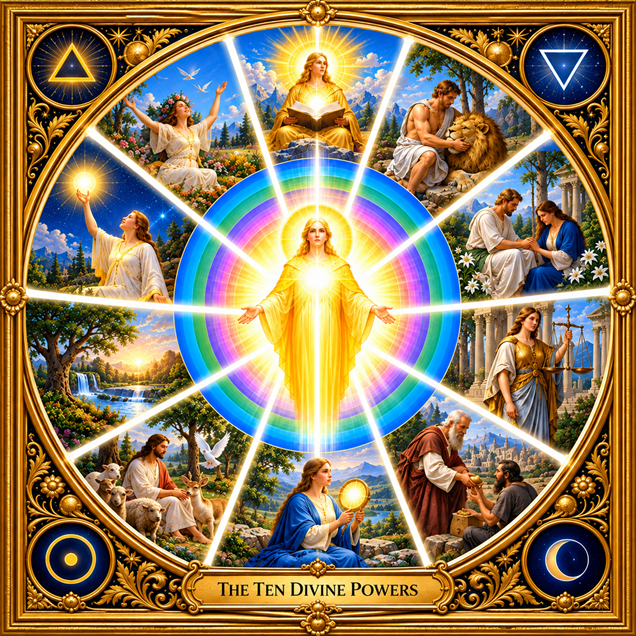
Truth is one of the Ten Divine Powers revealed in Corpus Hermeticum XIII, The Secret Sermon on the Mountain. In the Hermetic account of Spiritual Regeneration, Truth displaces the tormenting influence of Deceit, restoring the proper relationship between Knowledge, Understanding, and the Conscious expression of Reality. Truth is more than factual accuracy or the avoidance of false statements. It is the Recognition of what is Real, distinguished from the illusions, prejudices, and misconceptions through which the unregenerated Mind interprets existence. The pursuit of Truth requires the willingness to examine established beliefs, question appearances, and distinguish genuine Understanding from the mere acceptance of information.
Within Spiritual philosophy, Truth possesses both an intellectual and a transformative significance. Intellectual honesty seeks to determine what can reasonably be Known, while Spiritual Recognition concerns the deeper Understanding of Being and the individual's relationship with Divine Reality. These aspects need not oppose one another. The disciplined examination of evidence protects the Mind from error, while contemplation encourages inquiry into questions that extend beyond ordinary sensory experience. Truth becomes a Divine Power when the individual not only seeks Understanding but allows that Understanding to Transform Consciousness and conduct.
The Symbolism of the Woman and the Radiant Orb
Our illustration depicts a woman holding a radiant orb, an emblem of Illumination, Wisdom, and the Revealing Power of Truth. The orb's brilliant Light symbolizes Understanding emerging from the darkness of Ignorance, while its spherical form suggests Wholeness, Completeness, and the Universal character of Reality. The woman does not create the Light through personal authority; she holds it openly, representing the Conscious Recognition and expression of principles that exist independently of individual opinion. Her composed bearing suggests that genuine Understanding produces clarity rather than intellectual arrogance.
Light has long served as a philosophical symbol of Truth because it reveals what darkness conceals. Yet Illumination does not necessarily change the objects upon which it falls; it changes the observer's ability to perceive them. Similarly, Spiritual Understanding may Transform the individual's interpretation of Life without altering the fundamental principles governing existence. The radiant orb therefore represents more than accumulated Knowledge. It symbolizes the Awakening of discernment through which appearances are examined, illusions recognized, and the Mind gradually brought into Harmony with Reality.
Deceit and the Unregenerated Mind
Among the Twelve Tormentors, Deceit represents the distortion or concealment of Truth, whether directed toward others or practiced upon oneself. Deliberate dishonesty is its most recognizable expression, but Self-Deception may be even more difficult to overcome because the individual often remains unaware of its influence. Personal desires, fears, prejudices, and attachments can shape perception until convenient interpretations are mistaken for objective Reality. The Mind may defend cherished beliefs despite contradictory evidence, rationalize harmful conduct, or accept reassuring explanations simply because they preserve an established sense of identity.
Self-Deception obstructs Spiritual development by preventing honest Recognition of one's actual condition. A person cannot consciously Transform a weakness that is continually denied, nor develop Wisdom while refusing to acknowledge the limitations of existing Knowledge. Truth requires the courage to examine one's motives, admit uncertainty, and correct mistaken conclusions. This process may challenge familiar assumptions, but it also releases the individual from the necessity of defending what is false. The overcoming of Deceit therefore begins with sincerity toward oneself and develops into Greater Honesty in relationships, Judgment, and Action.
Knowledge, Understanding, and the Recognition of Truth
Knowledge provides information, but Understanding reveals relationships, principles, and significance. An individual may memorize philosophical teachings without comprehending their implications or recognize a principle intellectually without applying it in daily Life. Truth demands more than familiarity with words. It requires thoughtful examination, personal discernment, and the willingness to test one's conclusions against experience, reason, and the consequences of conduct. This distinction is particularly important in Spiritual study, where symbolic language and profound philosophical statements can easily be repeated without genuine comprehension.
The development of Understanding also requires intellectual Humility. Human perception is limited, interpretations may be mistaken, and even sincere convictions deserve examination. To recognize these limitations is not to abandon the search for Truth, but to pursue it with greater integrity. The individual learns to distinguish what is Known from what is believed, what has been directly experienced from what has been inferred, and what remains beyond present Understanding. Such discernment prevents the pursuit of Spiritual Knowledge from becoming another form of attachment to personal opinion.
Truth, Sincerity, and the Integrity of Expression
The Divine Power of Truth must become evident in the individual's manner of speaking and acting. Sincerity requires that words reflect genuine intention, that promises be honored, and that information not be deliberately distorted for personal advantage. Yet truthful expression also demands Wisdom. Accuracy does not justify unnecessary cruelty, and honesty should not become an excuse for humiliation or the careless disclosure of another person's private affairs. The responsible expression of Truth considers both the principle being communicated and the consequences of its communication.
Integrity develops when Thought, Speech, and Action increasingly reflect the same Understanding. An individual who publicly advocates Justice while privately practicing deception has not established Truth as a governing principle of Consciousness. Similarly, one who speaks sincerely but refuses to correct a demonstrated error has allowed pride to interfere with Understanding. Spiritual Truthfulness therefore involves continual Self-Examination, accountability, and the willingness to change. Its purpose is not to appear infallible, but to become increasingly faithful to what is genuinely recognized as Right and True.
The Infinite and the Limits of Definition
One of the profound questions within Hermetic philosophy concerns the relationship between the Infinite Divine Reality and the finite human Mind. Words, symbols, and philosophical concepts provide necessary instruments for inquiry, yet no definition can fully contain that which is understood to be Infinite and without limitation. The name given to a principle is not the principle itself, just as a description of Light is not the experience of Illumination. This distinction encourages the Seeker to approach Spiritual Understanding without confusing intellectual formulations with the Reality they attempt to express.
Recognition of the limits of language does not make Knowledge meaningless. Rather, it establishes the proper place of Knowledge within a larger process of Understanding. Philosophical teachings can direct attention, clarify distinctions, and prepare the Mind for deeper contemplation, but their value ultimately depends upon what the individual comes to Understand and express. Truth, in this sense, is not possessed as a personal achievement or confined within a particular vocabulary. It is approached through sincere inquiry, disciplined discernment, and an ever-deepening Awareness of the relationship between Consciousness and Being.
Truth and Spiritual Regeneration
Within the Hermetic process of Regeneration, Truth marks the overcoming of Deceit and the growing ability of the Soul to recognize and express Reality without deliberate distortion. Knowledge of God Awakens Spiritual Understanding; Self-Control establishes Inner authority; Continence refines Desire; Righteousness directs conduct toward Justice; and Generosity expresses Compassion through willing service. Truth strengthens these Powers by requiring sincerity in their application. Without Truth, Knowledge may become pretension, Self-Control may conceal ulterior motives, Righteousness may become hypocrisy, and Generosity may serve personal vanity rather than genuine Compassion.
The woman holding the radiant orb embodies this Transforming influence. Her Light symbolizes the Illumination through which the Mind recognizes its errors, examines its assumptions, and develops greater fidelity to Spiritual Understanding. The orb is held openly because Truth is not diminished through sincere communication; its influence may expand as Knowledge becomes Understanding in others. Yet Truth remains a Power of Regeneration rather than the final Realization of Divine Unity. It prepares the Soul for deeper Recognition by removing the distortions that obscure Reality and by establishing Integrity as a natural expression of Awakened Consciousness.
Truth is the Conscious Recognition of Reality, the courage to overcome Deceit and Self-Deception, and the Integrity to express through Thought, Word, and Action that which one genuinely Understands.