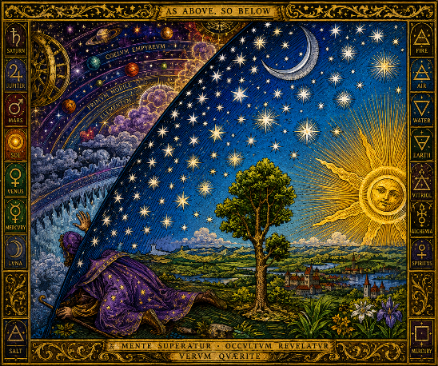
God is ALL in All
This is a Philosophical and Spiritual endeavor to extract, Harmonize, and synthesize the Universal Truths underlying the world's Diverse Religious, Mystical, and Philosophical traditions. Most famously associated with the concept of Perennial Philosophy, it posits that All Major Traditions share a single, transcendent metaphysical Source and Core Set of Truths.
"By the Power of Truth, I, while Living, have Conquered the Universe."
"I Am Nothing, yet I Am Everything."
Stoicism
I. Origins and the Practical Philosophy
Stoicism is one of the great philosophical traditions of the ancient world. Founded in Athens by Zeno of Citium around 300 BC, Stoicism taught that true happiness is not found in wealth, power, pleasure, or external success, but in living a life governed by wisdom, virtue, reason, and harmony with Nature. The philosophy flourished throughout the Greek and Roman worlds and reached its fullest expression through the writings of Seneca, Epictetus, and the Roman Emperor Marcus Aurelius.
Unlike many philosophical schools that focused primarily on abstract speculation, Stoicism was intended to be a practical guide for daily living. It sought to answer one of humanity's oldest questions: How can a person remain peaceful, virtuous, and free amid the uncertainties of life? Stoicism teaches that while we cannot control external events, we can always govern our own thoughts, attitudes, and actions. By mastering ourselves rather than attempting to master the world, we discover true freedom. From an esoteric perspective, Stoicism teaches that every human being participates in a Divine Order permeating the universe. Living in harmony with this Universal Reason brings peace, wisdom, and inner strength.
II. The Logos and the Divine Intelligence
At the heart of Stoic philosophy lies the concept of the Logos, the rational principle that governs the entire universe. The Stoics believed that the cosmos is not chaotic but ordered according to Divine Intelligence. Every event unfolds according to this universal law. Human beings possess reason because they participate in the Logos. Through rational thought, individuals can align themselves with the wisdom that governs Nature. Esoterically, the Logos represents the Divine Intelligence expressing itself throughout creation. Living according to reason is therefore living in harmony with the Divine Order itself.
III. Living in Accordance with Nature
One of the central teachings of Stoicism is to live according to Nature. Nature does not merely refer to forests, mountains, or the physical world. Rather, it signifies the universal order governing all existence and the true nature of human beings as rational and moral creatures. When individuals act according to wisdom, justice, courage, and moderation, they fulfill their natural purpose. Esoterically, living according to Nature means aligning the individual will with the greater harmony of the cosmos rather than struggling against it.
IV. Virtue as the Only True Good
Stoicism teaches that virtue alone is true happiness. External circumstances continually change. Wealth may disappear. Health may fail. Reputation may be lost. Even life itself eventually ends. Because these things lie beyond our complete control, they cannot provide lasting fulfillment. Instead, the Stoics taught that genuine happiness depends upon the cultivation of character. The Four Cardinal Virtues are: Wisdom, Courage, Justice, Temperance (Self-Control). A virtuous person remains inwardly free regardless of external circumstances. Esoterically, virtue represents the gradual refinement of the soul until it reflects the harmony of Divine Reason.
V. The Dichotomy of Control and Inner Freedom
Perhaps the best-known Stoic teaching is the distinction between what lies within our control and what does not.
Our judgments, choices, intentions, and actions belong to us. External events, other people's opinions, illness, fortune, and death do not. Peace comes from directing our energy toward what we can govern while accepting with serenity what we cannot.
This principle frees the individual from unnecessary anxiety and emotional turmoil. Esoterically, surrendering what cannot be controlled reflects trust in the wisdom of Divine Providence.
The Stoics believed that the greatest victory is Victory Over Oneself. True freedom is not the ability to do whatever one desires but the ability to govern one's desires wisely. Anger, fear, greed, envy, and uncontrolled passions enslave the individual.
By disciplining thought and emotion, one gradually becomes master of oneself rather than a servant of circumstance.
Esoterically, self-mastery represents the purification of consciousness.
Stoicism teaches that the universe unfolds according to Divine Providence. Although human beings cannot always understand why events occur, they may trust that everything participates in a greater order beyond immediate perception. Acceptance does not imply passivity, Rather, it means acting wisely while accepting outcomes beyond one's control. Esoterically, Providence reflects confidence that the Divine Intelligence governing the universe ultimately serves the harmony of the whole.
Stoicism is often misunderstood as teaching emotional suppression. In reality, the Stoics did not seek to eliminate emotion but to free themselves from destructive emotional reactions born of false judgments. Fear, hatred, jealousy, resentment, and excessive attachment arise when individuals mistake temporary circumstances for ultimate reality. Wisdom transforms these reactions into peace, compassion, courage, and equanimity. Esoterically, emotional balance reflects the quiet mind that mirrors the harmony of the cosmos.
VI. Universal Brotherhood and Daily Practice
Because every human being participates in the Logos, Stoicism teaches that all people belong to one universal family.
The Stoics considered themselves citizens of the world rather than merely citizens of a particular nation. Justice, kindness, fairness, and compassion naturally arise from recognizing our shared participation in Divine Reason.
Esoterically, humanity forms one spiritual community united by the same Divine Source.
Stoicism is a philosophy of continual practice. The Stoics recommended regular self-examination, reflection upon one's actions, and conscious cultivation of virtue. Marcus Aurelius wrote his Meditations as private reflections intended to strengthen his own character rather than to impress others. Daily reflection gradually develops wisdom by helping individuals recognize both their progress and their shortcomings. Esoterically, self-examination serves as an inner discipline through which consciousness becomes increasingly aligned with truth.
Stoicism teaches that death is a natural part of the universal order. Rather than fearing mortality, individuals should remember the temporary nature of earthly existence and therefore use each day wisely. Awareness of death encourages gratitude, humility, and purposeful living. Life becomes more meaningful when viewed within the larger perspective of eternity. Esoterically, contemplation of impermanence loosens attachment to transient forms and directs attention toward the enduring realities of the spirit.
The ultimate goal of Stoicism is inner tranquility. This peace does not depend upon favorable circumstances but arises from living in harmony with reason, virtue, and Divine Order. The Stoic remains steady during success and failure, praise and criticism, prosperity and adversity because true happiness rests within rather than without. Esoterically, inner peace reflects the soul that has learned to cooperate with the rhythm of the universe.