God is ALL in All
This is a Philosophical and Spiritual endeavor to extract, Harmonize, and synthesize the Universal Truths underlying the world's Diverse Religious, Mystical, and Philosophical traditions. Most famously associated with the concept of Perennial Philosophy, it posits that All Major Traditions share a single, transcendent metaphysical Source and Core Set of Truths.
"By the Power of Truth, I, while Living, have Conquered the Universe."
"I Am Nothing, yet I Am Everything."
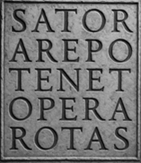
The Sator Square, one of the most famous and enigmatic word puzzles in history. You’ll find that this is much more than a simple palindrome; it is a profound Esoteric Talisman.
The square is a 5 x 5 grid containing five Latin words: SATOR, AREPO, TENET, OPERA, ROTAS. It is a two-dimensional palindrome, meaning it can be read:
Top-to-bottom
Bottom-to-top
Left-to-right
Right-to-left
The word TENET forms a perfect cross in the Center, acting as the "anchor" of the square.
While Latin scholars debate the exact meaning (as "Arepo" is a proper name or a hapax legomenon not found elsewhere in Latin literature), the most common translation is:
"The Sower Arepo holds with effort the wheels."
Sator: Sower, planter, or founder.
Arepo: Likely a proper name, or potentially related to a Celtic word for "plough."
Tenet: Holds, keeps, or masters.
Opera: Work, care, or effort.
Rotas: Wheels, or the cycle of fate.
The Sator Square holds several layers of hidden meaning:
1. The "Pater Noster" Rearrangement
In 1926, it was discovered that the 25 letters of the square can be perfectly rearranged into a cross forming the words PATER NOSTER (Our Father) twice, with two 'A's and two 'O's left over.
The A and O represent Alpha and Omega, the Beginning and the End.
Because of this, many believe it was a "crypto-Christian" symbol used by early Christians to identify one another without attracting Roman persecution.
2. In Hermetic traditions, the Square represents the Divine Architect (the Sator) governing the mechanism of the Universe (the Rotas). It symbolizes the idea that the Creator is present in every direction and every element of the "Great Work" (Opera).
3. Throughout the Middle Ages and into the Renaissance, the Sator Square was used as a magical talisman. It was believed to:
Extinguish fires (if written on a tablet and thrown into the flames).
Protect against evil spirits and "jinxes."
Ward off disease and fatigue.
The oldest known instance of the Sator Square was found in the ruins of Pompeii, meaning it dates back to at least 79 AD. It has since been found in Roman ruins in Britain, on the walls of Italian cathedrals, and in Ethiopian prayer amulets.
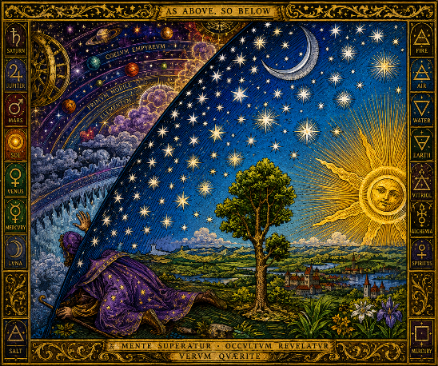
Its enduring Mystery lies in its perfect symmetry - a visual representation of the Hermetic maxim "As above, so below."