God is ALL in All
This is a Philosophical and Spiritual endeavor to extract, Harmonize, and synthesize the Universal Truths underlying the world's Diverse Religious, Mystical, and Philosophical traditions. Most famously associated with the concept of Perennial Philosophy, it posits that All Major Traditions share a single, transcendent metaphysical Source and Core Set of Truths.
"By the Power of Truth, I, while Living, have Conquered the Universe."
"I Am Nothing, yet I Am Everything."
Platonism
I. Origins and the Philosophical Tradition
Platonism is one of the most influential philosophical traditions in the history of Western civilization. Founded upon the teachings of the Greek philosopher Plato (c. 428–348 BCE), it explores the nature of reality, knowledge, virtue, the soul, and the Divine. While Plato is often remembered as a philosopher, his writings also contain profound spiritual insights that have inspired theologians, mystics, philosophers, and seekers for more than two thousand years. Plato viewed philosophy not merely as an academic discipline but as a transformative way of life. The purpose of philosophy was to awaken the soul from ignorance, leading it toward truth, wisdom, beauty, and ultimate communion with the highest Reality. Through disciplined reason, ethical living, and contemplation of eternal principles, the soul gradually ascends from the changing world of appearances to the unchanging realm of Divine Truth. Platonism profoundly influenced Neoplatonism, Hermeticism, early Christianity, Jewish philosophy, Islamic philosophy, Renaissance Humanism, and numerous mystical traditions.
II. The Theory of Forms and Eternal
One of Plato's central teachings is the distinction between the visible world and the intelligible world. The physical universe is constantly changing. Everything within it is born, grows, decays, and eventually passes away. Because it is always changing, it cannot be the ultimate reality. Beyond the physical universe exists an eternal realm of perfect realities that Plato called the Forms or Ideas. These Forms are timeless, immutable, and perfect. Everything we encounter in the material world is an imperfect reflection of these eternal archetypes. Esoterically, the visible world symbolizes manifestation, while the invisible realm of Forms represents the eternal spiritual reality from which all creation proceeds. The seeker's task is to look beyond appearances and perceive the eternal principles underlying all existence.
III. The Form of the Good and the Immortal Soul
Above all the Forms stands the Form of the Good, the supreme source of truth, beauty, justice, and existence itself. Just as the sun illuminates the physical world, the Good illuminates the intelligible world, making knowledge and understanding possible. The Good is not merely moral goodness but the highest principle of reality. Everything derives its existence and purpose from participation in the Good. Esoterically, the Good symbolizes the Absolute, the Divine Source, or the One from which all things proceed. It is the ultimate object of contemplation and the highest goal of the philosophical life.
Plato taught that the soul is immortal and preexists physical birth. Before entering the material world, the soul dwells in the realm of eternal realities. Embodiment temporarily obscures this knowledge, causing the soul to forget its true origin. The purpose of life is to awaken this forgotten wisdom and prepare the soul for its eventual return to the higher world. Death is therefore not the end of existence but the continuation of the soul's journey. Esoterically, the immortal soul represents the Divine essence within every human being. Although the personality changes throughout life, the deepest reality of the soul remains eternal.
IV. The Process of Recollection
Plato proposed that genuine knowledge is not acquired entirely through the senses but is, in part, a process of recollection (anamnesis). Because the soul has already encountered eternal truth before birth, learning is fundamentally the awakening of knowledge already present within. Philosophy therefore becomes an act of remembering rather than merely accumulating information. As the mind turns away from illusion and toward truth, the soul gradually recalls its Divine inheritance. Esoterically, recollection symbolizes spiritual awakening. Truth is not imposed from without but discovered within, as the soul recognizes its participation in eternal wisdom.
V. The Allegory of the Cave
Perhaps Plato's most famous teaching is the Allegory of the Cave. Prisoners confined within a cave mistake shadows cast upon a wall for reality. When one prisoner escapes into the sunlight, he discovers that the shadows were only reflections of a far greater world. The journey from darkness into light symbolizes the awakening of consciousness. Ignorance binds humanity to appearances, while philosophy leads the soul toward direct knowledge of reality. Esoterically, the cave represents limited consciousness. The shadows symbolize illusion, while the ascent into sunlight represents enlightenment and the realization of Divine Truth.
VI. Virtue, Beauty, and the Microcosm
Plato taught that virtue arises naturally from wisdom. When individuals truly understand what is good, they desire to live accordingly. The principal virtues—wisdom, courage, temperance, and justice—bring harmony to both the individual soul and society. Virtue is not merely external behavior but the proper ordering of one's inner life. The rational, emotional, and appetitive aspects of the soul must work together harmoniously under the guidance of wisdom. Esoterically, virtue purifies consciousness and prepares the soul for higher realization. A harmonious soul becomes capable of reflecting Divine Order.
For Plato, beauty possesses profound spiritual significance. Physical beauty awakens the soul's memory of eternal Beauty, encouraging it to seek ever higher expressions of truth and goodness. In the Symposium, Plato describes love as an ascent from attraction to physical beauty toward appreciation of moral beauty, intellectual beauty, and finally the contemplation of Beauty itself. Esoterically, beauty serves as a bridge between the visible and invisible worlds. Every experience of genuine beauty invites the soul to remember its Divine origin.
Plato regarded philosophy as preparation for the soul's liberation. The philosopher seeks to free the mind from domination by sensory appearances and cultivate contemplation of eternal realities. Study, dialogue, ethical discipline, self-examination, and meditation upon truth become means of spiritual transformation. The philosophical life gradually redirects the soul toward its highest purpose. Esoterically, philosophy is not merely reasoning but initiation into wisdom. It is the continual refinement of consciousness through the love of truth.
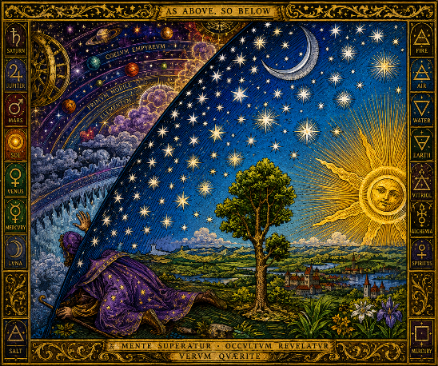
Plato taught that the human soul reflects the order found throughout the universe. The same principles governing the stars, nature, mathematics, and justice also govern the inner life. When individuals live according to reason, virtue, and truth, they participate consciously in the harmony of the cosmos. Disorder within the soul produces suffering, while harmony brings peace and fulfillment. This relationship between the microcosm and the macrocosm later became a cornerstone of Hermetic philosophy.
The ultimate goal of Platonism is the ascent of the soul toward direct contemplation of the Good. Through wisdom, virtue, philosophical inquiry, and contemplation, the individual gradually transcends ignorance and participates more fully in eternal reality. The philosopher seeks not simply to understand truth but to become transformed by it. As the soul grows in wisdom, it reflects ever more perfectly the Divine Order from which it originated.