
God is ALL in All
This is a Philosophical and Spiritual endeavor to extract, Harmonize, and synthesize the Universal Truths underlying the world's Diverse Religious, Mystical, and Philosophical traditions. Most famously associated with the concept of Perennial Philosophy, it posits that All Major Traditions share a single, transcendent metaphysical Source and Core Set of Truths.
"By the Power of Truth, I, while Living, have Conquered the Universe."
"I Am Nothing, yet I Am Everything."
Malice — The Destruction of What We Love
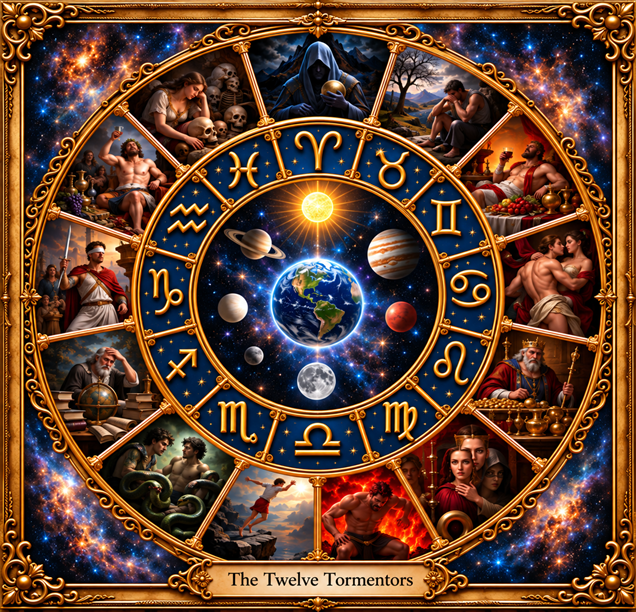
Continuing clockwise around the illustration, we encounter a sorrowful woman seated among numerous human skulls and skeletal remains. Her head is bowed, and one hand rests against her forehead while the other appears to touch or cradle a skull before her. The surrounding darkness creates an atmosphere of isolation, loss, and painful reflection. Unlike the preceding scenes, which often portray the Tormentors through recognizable emotions or actions, this illustration invites us to contemplate the consequences of destructive intentions after their effects have become apparent. At first glance, the woman might appear to represent Grief, for her posture and expression suggest profound sorrow. Yet within our interpretation of the Twelve Tormentors, the scene reveals another possibility: the aftermath of Malice. The skulls need not represent individuals who have physically died. They may symbolize relationships that have ended, trust that has been destroyed, affection that has been extinguished, and loved ones who have become emotionally separated from the individual through harmful words or actions. The woman may therefore represent a Soul confronting the consequences of its own past conduct. Those whom she once loved may now be lost to her, not necessarily through death, but through the destruction of the bonds that once united them. Her sorrowful expression suggests the possibility of remorse, perhaps accompanied by the painful recognition that certain consequences cannot easily be undone. This interpretation introduces an important distinction between Malice and the suffering that may follow it. Malice is the deliberate intention or disposition to cause harm, suffering, or misfortune to another. Remorse, by contrast, is the recognition and regret of harm that has already occurred. The two are not the same, although the consequences of malicious conduct may eventually awaken remorse in the individual responsible.
In Corpus Hermeticum XIII, Malice is identified as the Twelfth of the Tormentors associated with the Unregenerated human condition. Within our philosophical interpretation, it represents a condition in which Consciousness becomes directed toward the deliberate injury or misfortune of another person. Unlike the ordinary experience of anger, disappointment, or emotional pain, Malice involves an intention to cause suffering or a disposition that finds satisfaction in another's distress. This distinction is essential because not every harmful action arises from malicious intent. Human beings may injure one another through carelessness, ignorance, mistaken judgment, fear, or emotional reactions that were not deliberately intended to cause suffering. Such actions may still carry serious consequences and require personal responsibility, but they do not necessarily reveal the presence of Malice. The defining characteristic of Malice is the intention behind the harm, particularly when hostility becomes a Conscious desire to injure, punish, humiliate, or destroy something another person values. The illustration does not establish that the woman has committed any particular act of cruelty. Her sorrow may be interpreted in several ways, and we should not assume that outward suffering proves past wrongdoing. Within this study, however, we explore the possibility that she represents an individual who has come to recognize the destructive consequences of malicious intentions. The scene is therefore a symbolic meditation upon responsibility, loss, and the possibility of Transformation rather than a judgment upon a particular person.
There is a profound relationship between Malice and several of the other Tormentors. Envy may develop into Malice when resentment toward another person's advantages becomes a desire to see that person fail or suffer. Anger may contribute to Malice when an emotional reaction hardens into a sustained intention to injure. Avarice may encourage malicious conduct when another person is perceived as an obstacle to the acquisition of wealth or power, while Guile may be employed to conceal harmful intentions, manipulate relationships, or disguise destructive conduct beneath an appearance of sincerity. These connections illustrate how Malice may emerge through the interaction of several conditions of Consciousness rather than appearing as an isolated influence. Yet Malice possesses a distinctive characteristic: it directs destructive intention outward toward another person. The individual governed by Malice may believe that causing suffering will provide satisfaction, restore injured pride, settle an old grievance, or establish a sense of superiority. What begins as resentment may gradually become a deliberate wish to see another person deprived of happiness, security, dignity, or companionship. The consequences may extend far beyond the immediate object of hostility. Words intended to wound may permanently damage trust. Deliberate betrayal may destroy a friendship or family relationship. Acts of cruelty may create emotional suffering that continues long after the original conflict has ended. Sometimes the individual who intended to cause harm eventually discovers that the most enduring loss has occurred within personal Life. In seeking to injure another, the individual may have destroyed the very relationships through which affection, companionship, and meaning were once experienced.
The skulls surrounding the woman become especially meaningful when understood as symbols of relationships that have been damaged or lost. They need not represent physical death or literal violence. Instead, they may suggest the remains of friendships, family bonds, trust, affection, and opportunities for reconciliation that have been destroyed through destructive conduct. Their number emphasizes the possibility that the consequences of Malice may extend across many relationships and accumulate over time. The woman appears surrounded by reminders of what can no longer be restored simply through wishing that events had unfolded differently. Her bowed head and troubled expression suggest an Inward confrontation with the past. Perhaps she recognizes that Words Spoken with the intention to wound cannot always be forgotten, or that deliberate betrayal may permanently alter another person's willingness to trust. The scene therefore presents a painful paradox: an individual may seek satisfaction through causing another person suffering, only to discover that the resulting destruction has also diminished personal happiness. Yet the image should not be understood as declaring that every broken relationship results from Malice. Relationships may end through circumstances beyond anyone's control, through incompatibility, misunderstanding, or the legitimate need to establish personal boundaries. Nor should sorrow be interpreted as proof of guilt. The skulls serve as symbolic possibilities within our particular illustration, encouraging reflection upon the consequences of deliberately harmful conduct without assigning blame to those who have experienced loss.
Remorse introduces another important dimension to the illustration. The recognition that one's actions have caused suffering may produce profound regret, particularly when the consequences cannot easily be reversed. Yet remorse alone does not necessarily constitute Transformation. An individual may sincerely regret an outcome while continuing to justify the intentions or conduct that produced it. Genuine change requires more than sorrow over what has been lost; it requires a willingness to examine the motives behind the harmful behavior and accept responsibility for its consequences. This distinction becomes especially important when considering forgiveness and reconciliation. The individual who has caused harm cannot demand forgiveness or assume that remorse creates an obligation for others to renew a relationship. Trust may have been seriously damaged, and those who have suffered retain the right to determine whether reconciliation is possible or desirable. A sincere acknowledgment of wrongdoing does not erase another person's experience, nor does personal Transformation guarantee that every broken relationship can be restored. Nevertheless, the inability to reverse every consequence does not mean that personal Transformation is impossible. The Recognition of wrongdoing may become the beginning of a more compassionate Understanding of human relationships. Through reflection, responsibility, and changed conduct, the individual may learn to act differently in the future. The woman in the illustration may therefore represent a Soul standing at a profound turning point. She cannot change what has already occurred, but she may begin to understand the condition of Consciousness through which the harm arose. Her sorrow need not become another form of permanent bondage. It may become an opportunity for Self-Examination and the Awakening of a different way of Living.
Within the Hermetic understanding of Spiritual Regeneration, the Divine Power of the Good offers a particularly meaningful contrast to Malice. Where Malice directs intention toward injury and destruction, the Good represents the Higher Principle toward which regenerated Consciousness is oriented. Generosity, Truth, and Righteousness may also be understood as qualities that support the Transformation of destructive intentions into conduct guided by goodwill, sincerity, and moral responsibility.
These relationships are philosophical interpretations of the regenerative teaching rather than an assertion that Corpus Hermeticum XIII assigns one exclusive Divine Power to Malice. The ancient text presents Spiritual Regeneration through the coming of the Divine Powers, while our study considers how that Transformation might be understood in relation to the destructive intentions and consequences represented by the illustration. The Awakening of the Good involves more than simply refraining from deliberate harm. Within our interpretation, it encourages a fundamental change in the way Consciousness regards other individuals. Rather than perceiving another person's suffering as a source of satisfaction or advantage, the individual increasingly recognizes the value of goodwill, compassion, justice, and the preservation of meaningful relationships. This Transformation does not require the denial of past wrongdoing. On the contrary, an Honest Recognition of the past may provide the Understanding necessary to avoid repeating its destructive patterns. The woman surrounded by skulls therefore represents more than the destruction caused by Malice. She also symbolizes the possibility that Recognizing those consequences may Awaken a desire for Spiritual Transformation. The skulls remind us that some losses cannot be undone. Her sorrow suggests that Understanding may arrive only after the damage has occurred. Yet the capacity to Recognize wrongdoing and Seek a different path remains significant.
As the final scene in our illustrated sequence, Malice offers an especially meaningful conclusion to the study of the Twelve Tormentors. We began with Grief, contemplating the suffering that may overshadow Consciousness, and we now arrive at a scene in which suffering may have resulted from destructive intentions. The two images are not identical, nor do they suggest that all grief originates in wrongdoing. Rather, they remind us that human suffering has many causes, including circumstances beyond our control and the consequences of choices made by ourselves or others. Throughout these Twelve studies, we have encountered conditions that may obscure Spiritual Understanding in different ways. Ignorance limits Awareness, Desire and Intemperance may bind Consciousness to gratification, Avarice and Envy may distort our relationship with possessions and other people, while Guile, Anger, Rashness, Unrighteousness, and Error reveal further difficulties in the exercise of judgment and personal conduct. Malice brings our attention to the destructive consequences that may arise when hostility becomes a deliberate intention to harm.
Yet the purpose of Recognizing these conditions is not to condemn humanity or divide individuals into categories of Spiritual worth. It is to encourage the Honest Examination of Consciousness and the possibility of regeneration. The Twelve Tormentors are not presented in our study as permanent identities or an unavoidable sequence of trials. They are influences that may be Recognized, Understood, and Ultimately Overcome through the Awakening of a different relationship with the Divine. The lesson of Malice is not that individuals who have caused harm are beyond redemption, but that destructive intentions can damage the very relationships through which Love, Companionship, and Meaning are experienced. The Transformation of Consciousness begins when the individual ceases to justify the desire to harm and instead Recognizes the value of what has been injured or lost.
Malice may destroy what Love has built,
but Remorse can become
the Beginning of Transformation.