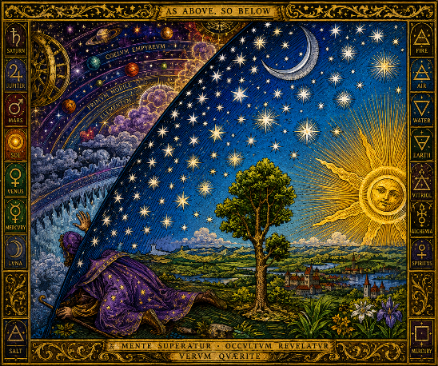
God is ALL in All
This is a Philosophical and Spiritual endeavor to extract, Harmonize, and synthesize the Universal Truths underlying the world's Diverse Religious, Mystical, and Philosophical traditions. Most famously associated with the concept of Perennial Philosophy, it posits that All Major Traditions share a single, transcendent metaphysical Source and Core Set of Truths.
"By the Power of Truth, I, while Living, have Conquered the Universe."
"I Am Nothing, yet I Am Everything."
Islam
I. Origins and the Prophet Muhammad
Islam is one of the world's largest monotheistic religions, with nearly two billion followers distributed across every continent. Founded in the seventh century CE in the Arabian Peninsula, Islam teaches Complete Submission to the One True God, known in Arabic as Allah, and obedience to His revealed Will. The word "Islam" itself means "submission" or "surrender," referring to the believer's Submission to God. Followers of Islam are called Muslims, meaning "those who Submit to God." Islam teaches that God has revealed His guidance through a long line of prophets, culminating in the Prophet Muhammad, whose teachings and revelations are recorded in the Qur'an. The religion emphasizes Faith, Worship, Moral Living, Compassion, Charity, and Accountability before God.
Islam originated in the city of Mecca, located in present-day Saudi Arabia, during the early seventh century CE. According to Islamic tradition, Muhammad ibn Abdullah was born in Mecca around 570 CE into the Quraysh tribe. Orphaned at a young age, he became known for his Honesty, Integrity, and Wisdom, earning the title "Al-Amin," meaning "the Trustworthy." As Muhammad matured, he became increasingly troubled by the widespread idolatry, tribal conflicts, injustice, and social inequalities present in Arabian society. Seeking solitude for prayer and reflection, he often retreated to the Cave of Hira outside Mecca.
At approximately forty years of age, Muhammad received his first revelation from God through the angel Gabriel. Muslims believe that Gabriel commanded Muhammad to "Read" or "Recite," beginning a series of Divine Revelations that continued over the next twenty-three years. These revelations were memorized by Muhammad's followers and later compiled into the Qur'an.
Muhammad's message proclaimed that there is only One God and called people to Abandon Idol Worship, Practice Justice, care for the poor, and prepare for the Day of Judgment. Many leaders in Mecca opposed his teachings because they threatened traditional religious practices and economic interests. In 622 CE, Muhammad and his followers migrated to the city of Medina in an event known as the Hijrah. This migration marks the beginning of the Islamic calendar. In Medina, Muhammad established a religious and political community based upon Islamic principles. Over the following years, Islam spread rapidly throughout Arabia. Before Muhammad's death in 632 CE, most of the Arabian Peninsula had accepted Islam. In the centuries that followed, Islamic civilization expanded across the Middle East, North Africa, parts of Europe, and Asia, becoming one of history's most influential religious and cultural traditions.
II. The Nature of God (Allah) and Core Beliefs
Muslims regard Muhammad as the final prophet and messenger of God, but not as Divine. Islam teaches that God has sent many prophets throughout history to guide humanity, including Adam, Noah, Abraham, Moses, David, Solomon, Jonah, John the Baptist, and Jesus. Muslims honor all of these figures as genuine prophets chosen by God. The Supreme Deity of Islam is Allah, the Arabic word for God. Muslims believe that Allah is the One Eternal Creator of the Universe, possessing perfect Knowledge, Wisdom, Mercy, Justice, and Power. God has no partners, no children, and no equals. He is Invisible, Beyond Human Comprehension, and cannot be represented by physical images or idols. One of the most important teachings of Islam is the Absolute Oneness of God, known as Tawhid. This doctrine affirms that only God deserves Worship and that associating any other being with Him is the gravest sin in Islam. Muslims believe that Muhammad is the "Seal of the Prophets," meaning that he is the final prophet through whom God completed His revelation to humanity. While deeply honored and respected, Muhammad is Worshiped neither as God nor as a Divine Being but as God's Faithful Servant and Messenger.
III. The Six Articles of Faith and the Five Pillars
The central beliefs of Islam are summarized in the Six Articles of Faith and the Five Pillars of Islam. Muslims believe in One God, His angels, His revealed books, His prophets, the Day of Judgment, and God's Divine Knowledge and Sovereignty over Creation. The Five Pillars of Islam provide the foundation of Muslim religious practice. The First Pillar is the declaration of Faith, known as the Shahada, which states: "There is no god but Allah, and Muhammad is the Messenger of Allah." This declaration affirms belief in God's Oneness and Muhammad's prophetic mission. The Second Pillar is Salah, the practice of praying five times each day while facing the Kaaba in Mecca. These daily prayers remind Muslims of their continual dependence upon God. The Third Pillar is Zakat, the obligation to give a portion of one's wealth to assist the poor and support charitable causes. Charity is viewed as both a religious duty and an expression of compassion. The Fourth Pillar is Sawm, the fasting observed during the month of Ramadan. From dawn until sunset, Muslims abstain from food, drink, and other physical pleasures while focusing upon Prayer, Self-Discipline, Repentance, and Generosity. The Fifth Pillar is the Hajj, the pilgrimage to Mecca that every physically and financially able Muslim is expected to perform at least once during his or her lifetime. The pilgrimage symbolizes the Unity of believers before God and commemorates events associated with Abraham and his family. Islam also teaches the importance of Honesty, Justice, Mercy, Forgiveness, Modesty, Patience, Gratitude, and Respect for parents and neighbors. Muslims believe that Every Individual is Accountable to God for his or her actions and will be judged after death.
IV. The Qur'an and Islamic Guidance
The primary sacred scripture of Islam is the Qur'an, which Muslims believe to be the literal Word of God as revealed to Muhammad through the angel Gabriel. The Qur'an is written in Arabic and consists of 114 chapters known as surahs. It addresses Theology, Morality, Worship, Law, History, and Guidance for daily Life. Muslims believe that the Qur'an perfectly preserves God's final revelation without alteration. Because of this belief, the Arabic text is regarded as uniquely authoritative, although translations are widely used to assist non-Arabic speakers. In addition to the Qur'an, Muslims rely upon the Hadith, collections of sayings and actions attributed to the Prophet Muhammad. These traditions help explain the teachings of the Qur'an and provide Practical Guidance for Worship, Ethics, and Community Life.
V. Worship and the Fast of Ramadan
Muslims gather for communal Worship in buildings known as Mosques. Friday is considered the principal day of congregational Worship, during which Muslims assemble for prayer and a sermon delivered by an Imam. Daily prayer is among the most visible practices of Islam. Before praying, Muslims perform ritual washing known as wudu, symbolizing Spiritual and Physical Purity. During prayer, Worshipers stand, bow, kneel, and prostrate themselves before God while reciting passages from the Qur'an.
Fasting during Ramadan is both a Physical and Spiritual Discipline. In addition to abstaining from food and drink during daylight hours, Muslims devote increased attention to prayer, reading the Qur'an, charitable giving, and acts of kindness.
Two major religious festivals are celebrated each year. Eid al-Fitr marks the conclusion of Ramadan with communal prayers, family gatherings, and charitable giving. Eid al-Adha commemorates Abraham's willingness to obey God by sacrificing his son and coincides with the annual pilgrimage to Mecca.
VI. The Ummah and the Sunni-Shia Division
One of Islam's defining characteristics is its emphasis upon the Unity of God and the Equality of All Believers before Him. Regardless of nationality, ethnicity, wealth, or social status, Muslims stand side by side in prayer as equals. Another distinctive feature is the comprehensive nature of Islamic teaching. Islam provides guidance concerning personal morality, family relationships, business ethics, charity, worship, and community responsibilities. Many Muslims understand religion Not Simply as a set of beliefs but as a Complete Way of life.
Following the death of Muhammad, disagreements concerning leadership led to the development of Islam's two largest branches: Sunni and Shia Islam. Sunni Muslims comprise approximately eighty-five to ninety percent of the global Muslim population and believe that Muhammad's successor should have been chosen by the Muslim community. Shia Muslims believe that leadership rightfully belonged to Ali, Muhammad's cousin and son-in-law, and his descendants. Although these branches differ in certain historical and theological matters, they share the Central Beliefs Concerning One God, the Qur'an, Muhammad's prophethood, and the Five Pillars of Islam.
VII. Modern Islam and Global Impact
Today, Islam is practiced by nearly two billion people worldwide and is the majority religion in many countries across the Middle East, North Africa, Central Asia, South Asia, and Southeast Asia. Significant Muslim communities also reside in Europe, North America, Sub-Saharan Africa, and Australia. Muslims contribute to every area of modern society, including education, medicine, science, engineering, business, literature, politics, and humanitarian work. Throughout history, Islamic civilization has made important contributions to mathematics, astronomy, medicine, architecture, philosophy, and the preservation of ancient knowledge. Modern Muslim communities continue to balance the preservation of their religious traditions with engagement in an increasingly interconnected global society while Emphasizing Faith in God, Family Life, Charitable Service, and Moral Responsibility.