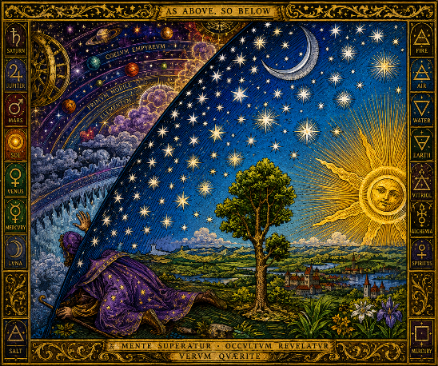
God is ALL in All
This is a Philosophical and Spiritual endeavor to extract, Harmonize, and synthesize the Universal Truths underlying the world's Diverse Religious, Mystical, and Philosophical traditions. Most famously associated with the concept of Perennial Philosophy, it posits that All Major Traditions share a single, transcendent metaphysical Source and Core Set of Truths.
"By the Power of Truth, I, while Living, have Conquered the Universe."
"I Am Nothing, yet I Am Everything."
Indigenous Spirituality
I. Origins and the Universal Worldview
Indigenous Spirituality represents the ancient spiritual traditions of the world's First Peoples. Although each Indigenous culture possesses its own unique beliefs, ceremonies, sacred stories, and understanding of the Divine, many share common spiritual principles that have endured for thousands of years. These traditions developed independently across every inhabited continent, including the Americas, Australia, Africa, Asia, and the Arctic, yet they reveal remarkable similarities in their reverence for nature, respect for ancestral wisdom, and recognition of the sacredness of all life. Unlike many organized religions, Indigenous Spirituality is not founded upon a single prophet, sacred book, or universal creed. Instead, its teachings have traditionally been preserved through oral tradition, ceremonial practices, songs, symbols, and the lived experience of each generation. Spiritual knowledge is regarded as something to be experienced rather than merely believed, and wisdom is transmitted through elders who have demonstrated both knowledge and integrity. At its heart, Indigenous Spirituality teaches that humanity is not separate from creation but an integral part of the great web of life. Every mountain, river, forest, animal, and human being participates in a living, sacred universe sustained by the Great Spirit or Divine Source.
II. The Great Spirit and the Living Universe
Many Indigenous traditions speak of a Supreme Creator, often referred to as the Great Spirit, Great Mystery, Great Creator, or by names unique to each culture. This Divine Presence is understood as the source of all life and the sustaining power behind the visible and invisible worlds. The Great Spirit is not viewed as distant or removed from creation but as continually present within it. The Divine is revealed through the beauty of nature, the changing seasons, the movement of the stars, the cycles of life, and the quiet wisdom found in every living thing. Esoterically, the Great Spirit represents the Infinite Life that permeates the entire universe. Rather than existing apart from creation, the Divine is experienced as the living Presence within all existence.
III. The Interconnectedness of All Life
One of the defining characteristics of Indigenous Spirituality is the recognition that all life is sacred. Humanity does not stand above nature but lives within an interconnected community of life where every being possesses purpose, dignity, and value.
Animals are often regarded as teachers, plants as healers, rivers as life-givers, and mountains as places of spiritual power. Every part of creation contributes to the harmony of the whole. This understanding encourages humility, gratitude, and respect for all living things. Esoterically, the unity of life reflects the realization that one Divine Life expresses itself through countless forms while remaining eternally One.
IV. Harmony with Nature and the Symbol of the Circle
Rather than seeking to dominate nature, Indigenous traditions emphasize living in harmony with its rhythms and cycles. Human beings are called to observe, learn from, and cooperate with the natural world rather than exploit it. The changing seasons, migration of animals, phases of the moon, and movements of the heavens are often regarded as expressions of Divine Order that guide both physical and spiritual life. Living harmoniously with nature promotes balance within the individual, the community, and the environment. Esoterically, harmony with nature reflects the recognition that the same spiritual laws governing the universe also govern human life.
Many Indigenous traditions use the symbol of the circle to represent the continuity and unity of existence. Life moves in cycles rather than straight lines. Birth follows death, spring follows winter, and each generation contributes to the continuing journey of the people. The circle symbolizes completeness, equality, eternity, and the interconnectedness of all beings. Ceremonies are frequently conducted in circles to remind participants that every individual occupies an equal place within the larger community of life. Esoterically, the circle represents the eternal nature of Spirit and the continuous unfolding of Divine Life throughout creation.
V. Ancestor Veneration and Sacred Ceremonies
The wisdom of the ancestors occupies a place of profound importance within Indigenous Spirituality. Those who have gone before remain honored through stories, ceremonies, prayers, and remembrance. Their experiences provide guidance for future generations. Traditions are preserved not simply because they are old but because they embody the accumulated wisdom of countless generations living in relationship with the land and with the Divine. The living community and the ancestral community remain spiritually connected. Esoterically, the ancestors represent the continuity of consciousness that transcends physical death and reminds humanity that spiritual wisdom belongs to every generation.
Ceremony serves as one of the principal means by which Indigenous peoples maintain their relationship with the Divine. Rituals marking birth, adulthood, marriage, harvest, healing, thanksgiving, and death affirm humanity's participation in the sacred order of life. Prayer, drumming, chanting, dancing, fasting, vision quests, purification ceremonies, and offerings all provide opportunities to renew spiritual awareness and strengthen the bond between humanity and the Creator. These ceremonies are not merely symbolic but are understood as living encounters with the sacred. Esoterically, ceremony becomes a means through which human consciousness is brought into harmony with the spiritual realities underlying the visible world.
The Earth is regarded not merely as property or a collection of natural resources but as a sacred trust entrusted to humanity's care. The land nourishes life physically, emotionally, and spiritually. Many Indigenous traditions teach that every generation bears responsibility for preserving the Earth for those yet unborn. Decisions are often considered in light of their effect upon future generations. Respect for the Earth therefore becomes both a spiritual obligation and an ethical responsibility. Esoterically, the Earth symbolizes the Divine manifestation through which Spirit continually reveals itself.
VI. Experiential Knowledge and Community Balance
Indigenous Spirituality teaches that true wisdom arises through direct experience rather than intellectual knowledge alone. Silence, observation, contemplation, dreams, visions, and communion with nature all become teachers. The individual learns by listening deeply to both the outer world and the inner voice of Spirit. Knowledge is measured not by the amount of information one possesses but by the degree to which one's life reflects harmony, humility, compassion, and wisdom. Esoterically, direct experience represents the awakening of intuitive consciousness beyond ordinary reasoning.
The individual is inseparable from the larger community. Every person's actions affect the well-being of family, tribe, nation, and the natural world. Cooperation, generosity, mutual respect, and service are regarded as essential virtues because the health of the whole depends upon the integrity of each member. Spiritual maturity is demonstrated not through personal achievement alone but through one's contribution to the welfare of others. Esoterically, community reflects the spiritual truth that humanity forms one interconnected family within the larger community of creation.
Balance represents one of the highest ideals in Indigenous Spirituality. Human beings seek harmony between body and spirit, individuality and community, action and contemplation, humanity and nature, the physical and the spiritual. Illness, conflict, and suffering often arise when this natural balance is disturbed. Healing therefore involves restoring right relationship with oneself, others, nature, and the Divine. Living in balance becomes both the path and the goal of spiritual life. Esoterically, balance reflects the universal principle that harmony arises when every aspect of life aligns with Divine Order.