God is ALL in All
This is a Philosophical and Spiritual endeavor to extract, Harmonize, and synthesize the Universal Truths underlying the world's Diverse Religious, Mystical, and Philosophical traditions. Most famously associated with the concept of Perennial Philosophy, it posits that All Major Traditions share a single, transcendent metaphysical Source and Core Set of Truths.
"By the Power of Truth, I, while Living, have Conquered the Universe."
"I Am Nothing, yet I Am Everything."
Ignorance — The Illusion of Knowledge
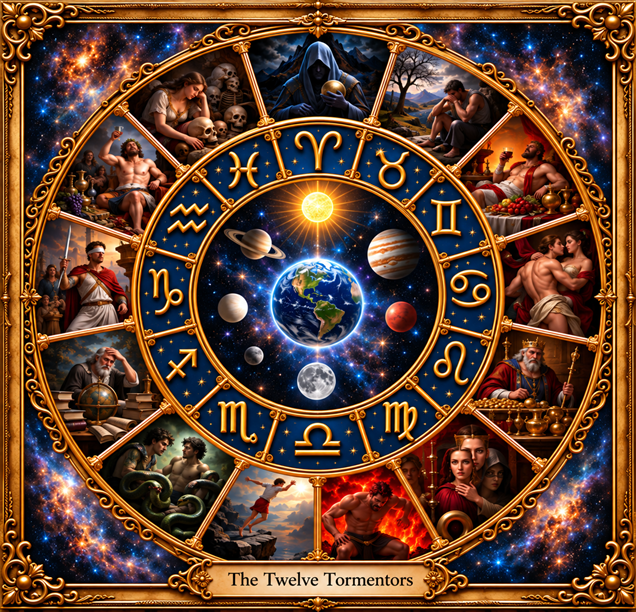
Continuing clockwise around the illustration, we encounter an elderly scholar seated among numerous books, manuscripts, and instruments of learning. Before him stands a celestial globe, suggesting a lifetime devoted to studying the Universe and humanity's place within it. Yet despite the wealth of knowledge surrounding him, the scholar appears deeply troubled. His hand rests upon his forehead, and his expression suggests contemplation, uncertainty, or the painful Realization that important questions remain unanswered. The scene presents an intriguing philosophical paradox: how can an individual surrounded by so much Knowledge represent Ignorance? The answer lies in Recognizing that the possession of information does not necessarily constitute complete Understanding. The books symbolize accumulated Knowledge, education, intellectual achievement, and the Wisdom preserved through generations of human inquiry. The celestial globe represents the effort to comprehend the structure of the Universe, the movements of the heavens, and the relationship between humanity and the greater Cosmos. These pursuits are not presented as meaningless or undesirable. On the contrary, the desire to Learn and Understand is among the most valuable qualities of human Consciousness. Yet the scholar's troubled expression reminds us that even a lifetime of study cannot reveal everything there is to know.
In Corpus Hermeticum XIII, Ignorance is identified as the first of the Twelve Tormentors associated with the Unregenerated condition of the Soul. Within our philosophical interpretation, it is not necessarily a moral failing, a sign of inferior intelligence, or a condition deserving ridicule or condemnation. Ignorance, in its ordinary meaning, is simply the Absence of Knowledge or Understanding. It is not necessarily a fault, and every human being begins life without Knowledge of the world and gradually develops Understanding through observation, education, experience, and reflection. Even the most accomplished scholar remains ignorant of countless things beyond the limits of personal Knowledge. In this sense, Ignorance is a natural condition that invites the discovery of Knowledge. The difficulty arises when an individual becomes unwilling to recognize the limitations of personal Understanding, or mistakes accumulated information for a complete comprehension of reality. In Corpus Hermeticum XIII, however, Ignorance possesses a particularly significant Spiritual meaning. It is associated with the Unregenerated condition of the Soul, whose Awareness remains obscured by its failure to Recognize the Divine nature of existence. The corresponding Divine Power, Knowledge of God, represents the Awakening through which this fundamental Spiritual Ignorance begins to be Overcome.
This introduces an important distinction between Intellectual Knowledge and Spiritual Understanding. Intellectual Knowledge develops through the study of facts, principles, observations, and explanations. It enables humanity to understand the natural world, preserve discoveries, develop technologies, and communicate ideas across generations. Spiritual Understanding, within the Hermetic tradition, concerns the Soul's Recognition of its relationship with the Divine and the deeper nature of existence. These forms of Understanding need not oppose one another. Intellectual inquiry may encourage reflection upon profound philosophical questions, while Spiritual contemplation may inspire a deeper appreciation of the Universe and humanity's place within it. Nevertheless, the accumulation of information alone does not guarantee the Awakening of Spiritual Consciousness. A person may possess an extensive Knowledge of religious scriptures, philosophical doctrines, alchemical symbolism, and ancient mysteries while remaining uncertain about their deeper significance. Likewise, an individual with little formal education may demonstrate remarkable Wisdom, Compassion, Humility, and Spiritual Insight. The distinction is therefore not between educated and uneducated individuals, but between the possession of information and the development of genuine Understanding. The elderly scholar's expression becomes especially meaningful when considered in this light. Perhaps he is not distressed because his studies have failed. Perhaps he has reached a point in his intellectual journey where he recognizes the vastness of what remains unknown. The more deeply he examines the Universe, the more clearly he perceives the limitations of his own Understanding. Such Recognition need not represent defeat. It may become the beginning of a more profound search for Wisdom.
There is also a significant relationship between Ignorance and Error, another of the Twelve Tormentors. Ignorance concerns the Absence of Knowledge or Understanding, while Error concerns the acceptance of something mistaken as true or the formation of an incorrect judgment. An individual may be ignorant of a particular subject without holding any false beliefs about it. Conversely, someone may possess considerable information yet arrive at an erroneous conclusion through mistaken reasoning or incomplete interpretation. The two conditions may influence one another. Ignorance can contribute to Error when important information is missing, while Error can preserve Ignorance when mistaken assumptions prevent the individual from recognizing the need for further learning. Both conditions may be overcome through the willingness to examine, question, learn, and reconsider what is believed to be understood. This distinction will become especially important when we examine Error as a separate Tormentor later in our illustrated sequence.
The symbolism of the celestial globe also deserves attention. The globe represents the observable Universe and humanity's continuing effort to comprehend its structure. Yet the scholar who studies the Heavens is himself part of the Universe he Seeks to Understand. This introduces a fundamental philosophical question: Can an individual fully understand the world without also examining the Consciousness through which that world is perceived? Within Hermetic philosophy, the search for Understanding extends beyond the observation of external phenomena. It also invites contemplation of the nature of the Soul, the Divine Mind, and the relationship between the individual and the greater order of existence. The scholar's books and instruments may reveal much about the world around him, but they cannot substitute for the Inward Recognition associated with Spiritual Regeneration. This does not diminish the importance of learning. Rather, it suggests that the pursuit of Wisdom may require both Intellectual investigation and Honest Self-Examination. “Know Thyself.” — Ancient Greek Delphic Maxim
Within the Hermetic understanding of Regeneration, Knowledge of God is the Divine Power that directly addresses the condition of Spiritual Ignorance. This Knowledge is not merely the memorization of sacred teachings or the acceptance of established doctrines. It concerns a Transformation of Consciousness through which the Soul comes to Recognize its relationship with the Divine. The distinction is important because the ability to explain a philosophical teaching is not necessarily the same as having attained the Understanding toward which that teaching points. The scholar's apparent uncertainty may therefore be understood as a meaningful stage in the pursuit of Understanding. The Recognition that one's Knowledge is incomplete can encourage Humility, Curiosity, and the willingness to Seek a Deeper Truth. The scene does not portray a foolish man surrounded by books he cannot understand. It portrays the human condition itself: the extraordinary capacity to acquire knowledge, accompanied by the continuing Realization that existence contains mysteries not yet comprehended.
The lesson of Ignorance is not that the individual should abandon intellectual learning, but that learning should remain an open and continuing pursuit rather than becoming a source of unquestioning certainty. Ignorance need not be feared or condemned. It becomes an obstacle only when the individual refuses the opportunity to move beyond it. The scholar reminds us that genuine Wisdom does not require the possession of every answer. It begins with the Humility to Recognize what remains unknown and the Willingness to continue Seeking Understanding.
Ignorance is Not a Failure of the Soul,
but an Invitation to Seek Understanding.
Wisdom begins when we Recognize
how much remains to be Learned.