God is ALL in All
This is a Philosophical and Spiritual endeavor to extract, Harmonize, and synthesize the Universal Truths underlying the world's Diverse Religious, Mystical, and Philosophical traditions. Most famously associated with the concept of Perennial Philosophy, it posits that All Major Traditions share a single, transcendent metaphysical Source and Core Set of Truths.
"By the Power of Truth, I, while Living, have Conquered the Universe."
"I Am Nothing, yet I Am Everything."
The Hooded Figure — The Unawakened Soul
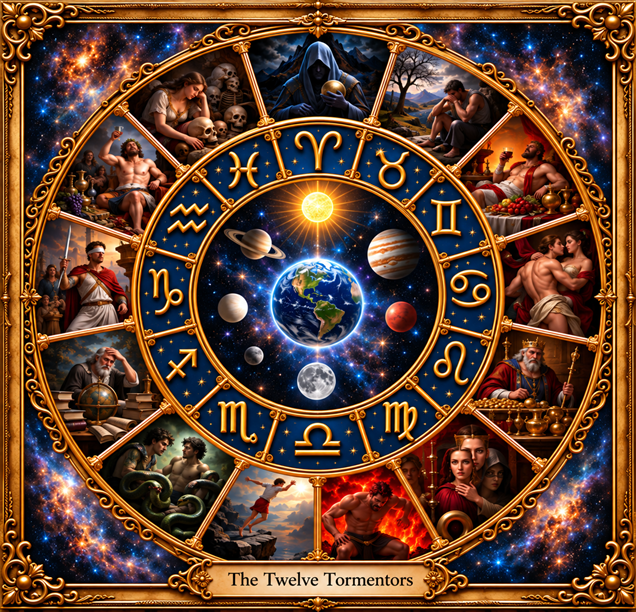
At the summit of the illustration stands a mysterious hooded figure, shrouded in darkness, its face concealed from view. Unlike the Twelve surrounding scenes, this thirteenth image does not represent another Tormentor. Rather, it symbolizes the human Soul subjected to the Twelve Tormentors because it has not yet Awakened to the Recognition of the Divine Light.
The dark hood represents the veil of Spiritual Ignorance, a condition in which Consciousness perceives existence primarily through the limitations of the material senses. The concealed face suggests an identity not yet fully understood, a Soul that experiences the world around it without Recognizing the deeper Spiritual Reality Within Itself.
In Corpus Hermeticum, Book XIII, Hermes Trismegistus explains to his disciple Tat that Twelve Tormentors afflict the Inner human being. In this study, these Tormentors are understood not as external demons or supernatural creatures, but as conditions of Ignorance, Passion, and Error that obscure Spiritual Understanding. Their influence binds Consciousness to the appearances and distractions of material existence, preventing the Soul from Recognizing its Higher nature.
The golden sphere held by the hooded figure introduces an important contrast to the surrounding darkness. In this artistic interpretation, the sphere represents the Divine Potential already present Within the human Soul. Although the figure remains veiled in Ignorance, the golden sphere suggests that the possibility of Spiritual Awakening has never been absent. The Soul possesses the capacity for Illumination even before it becomes Consciously Aware of that capacity.
The figure's position above the Twelve surrounding scenes establishes its relationship to the entire composition. It represents the human condition in which the Twelve Tormentors operate, while the individual scenes reveal the various passions and errors through which Spiritual Understanding becomes obscured.
This condition may also be understood through the biblical imagery of the "valley of the shadow of death" in Psalm 23. The valley need not represent physical death alone, but may also be contemplated as a passage through darkness, uncertainty, and Spiritual Unawareness. Just as the Psalm describes a journey through the valley rather than permanent residence within it, the Hermetic teaching presents Ignorance as a condition from which the Soul may emerge through Spiritual Regeneration.
The comparison is philosophical rather than historical; the biblical Psalm and the Hermetic discourse belong to different traditions, yet both offer imagery through which the passage from darkness toward Spiritual Understanding may be contemplated.
The hooded figure therefore represents neither an evil being nor a Soul condemned to perpetual suffering. It symbolizes humanity before Spiritual Awakening, when the Divine Light remains unrecognized beneath the accumulated veils of Ignorance and the Passions.
Its presence introduces the central mystery explored throughout the illustration: the Twelve Tormentors do not define the essential nature of the Soul. They describe the conditions from which the Soul must be Liberated.
Through the Ten Divine Powers described in the Hermetic teaching, these Tormentors are Overcome, and Consciousness Awakens to a Reality previously concealed by Ignorance.
The Light does not have to be
Created Within the Soul.
It has to be Recognized.