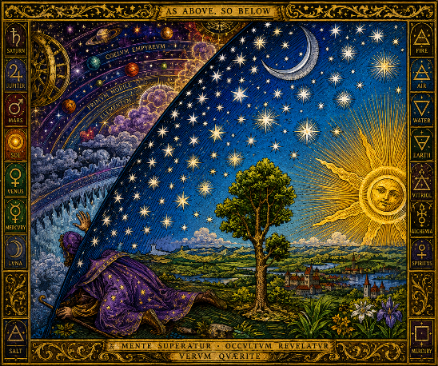
God is ALL in All
This is a Philosophical and Spiritual endeavor to extract, Harmonize, and synthesize the Universal Truths underlying the world's Diverse Religious, Mystical, and Philosophical traditions. Most famously associated with the concept of Perennial Philosophy, it posits that All Major Traditions share a single, transcendent metaphysical Source and Core Set of Truths.
"By the Power of Truth, I, while Living, have Conquered the Universe."
"I Am Nothing, yet I Am Everything."
Hinduism
I. Origins and the Evolution of the Tradition
Hinduism is the world's oldest major Living religion and is practiced by more than one billion people, making it the third-largest religion in the world after Christianity and Islam. Unlike many other major religions, Hinduism has no single founder, no single historical beginning, and no central governing authority. Instead, it developed gradually over thousands of years in the Indian subcontinent through the Blending of Religious Beliefs, Philosophical Teachings, Cultural Traditions, and Sacred Writings. Hinduism encompasses a wide variety of beliefs and practices, yet its followers share a Common Understanding of the Divine, the Moral Law Governing the Universe, and the Ultimate Purpose of human Life. The religion Emphasizes Spiritual Growth, Moral Responsibility, and the Pursuit of Liberation from the cycle of Birth and Rebirth.
The origins of Hinduism can be traced to the civilizations of the Indus River Valley, which flourished between approximately 2500 and 1500 BCE in what is now Pakistan and northwestern India. Although many aspects of the Indus Valley religion remain uncertain, archaeological evidence suggests that its people practiced rituals, honored sacred animals, and held beliefs that later influenced Hindu traditions. Following the arrival of Indo-Aryan peoples in northern India around 1500 BCE, religious beliefs evolved through the composition of the Vedas, the oldest sacred writings of Hinduism. Over many centuries, religious teachers, philosophers, and sages expanded these teachings through additional scriptures and philosophical works. Rather than emerging from the teachings of a single prophet, Hinduism developed gradually as generations of Thinkers sought to Understand the Nature of God, Humanity, and the Universe. As the religion evolved, numerous schools of philosophy and methods of worship emerged. While practices differ among various Hindu communities, they are United by shared beliefs concerning Karma, Reincarnation, Dharma, and the Pursuit of Spiritual Liberation. This diversity has enabled Hinduism to remain one of the world's most enduring and adaptable religious traditions.
II. Brahman, the Divine Reality, and the Deities
Unlike Christianity, Islam, Buddhism, or Sikhism, Hinduism does not have a single founder or one individual regarded as its prophet. Instead, its teachings have been shaped by countless Sages, Scholars, and Spiritual Leaders over thousands of years.
Hindu belief concerning God varies among its different traditions. Many Hindus believe in One Supreme, Eternal Reality known as Brahman. Brahman is Understood to be the Ultimate Spiritual Reality that Exists beyond Time and Space and is the Source of All Existence. Although Brahman is Infinite and Without Physical Form, it is believed to reveal itself in many different ways that people can understand and worship. Among the most widely worshiped deities are Brahma, the Creator; Vishnu, the Preserver; and Shiva, the Destroyer or Transformer. Together they are often referred to as the Trimurti, Representing different aspects of the work of the One Ultimate Divine Reality. Many Hindus devote themselves primarily to one deity while recognizing that all ultimately represent manifestations of Brahman. Vishnu is believed by many Hindus to have appeared on earth through a series of Divine Incarnations, known as Avatars, whenever righteousness declines and evil becomes dominant. Two of the most beloved Avatars are Rama, the hero of the Ramayana, and Krishna, whose teachings in the Bhagavad Gita have become central to Hindu philosophy and devotion.
III. Dharma, Karma, and the Cycle of Rebirth
One of the foundational concepts of Hinduism is Dharma, a term that Refers to Moral Duty, Righteous Conduct, and Living according to the Natural and Divine Order of the Universe. Every individual has responsibilities determined by age, family, occupation, and stage of life. Fulfilling one's dharma is considered essential for both personal well-being and social harmony.
Another central teaching is Karma, the Universal Law of Cause and Effect. Hindus believe that Every Thought, Word, and Action produces Consequences that Influence both the Present Life and Future Lives. Good actions generate Positive Karma, while harmful actions create Negative Karma. This moral law encourages ethical behavior and personal responsibility. Closely connected to Karma is the belief in Samsara, the Continual Cycle of Birth, Death, and Rebirth. According to Hindu teaching, the Soul, or Atman, is Eternal and passes through many lifetimes as it progresses Spiritually. The circumstances of each new life are influenced by the karma accumulated in previous existences.
IV. Moksha and the Path of Liberation
The Ultimate Goal of Hindu Life is Moksha, or Liberation from the Cycle of Reincarnation. Moksha is achieved through Realizing the Soul's Unity with Brahman and Overcoming Ignorance, Selfish Desire, and Attachment to the Material World. Different Hindu traditions teach various paths toward this goal, including Devotion to God, Selfless Service, Meditation, Knowledge, and Disciplined Moral Living. Hinduism also encourages the practice of Nonviolence, known as Ahimsa. Respect for All Living Beings arises from the belief that the same Divine Reality Exists Within Every Creature. Compassion, Truthfulness, Self-Control, Generosity, Humility, and Respect for others are considered Essential Virtues.
V. Sacred Literature and Diverse Practices
Hinduism possesses one of the largest collections of sacred literature of any religion. The oldest scriptures are the four Vedas: the Rig Veda, Sama Veda, Yajur Veda, and Atharva Veda. These writings contain hymns, prayers, rituals, and theological teachings that form the earliest foundation of Hindu belief. The Upanishads, composed later, explore profound philosophical questions concerning God, the Soul, Reality, and the Meaning of Existence. These writings introduced many of the concepts that continue to shape Hindu thought today, including Brahman, Atman, Karma, and Moksha. Among the most influential sacred texts is the Bhagavad Gita, a section of the great epic known as the Mahabharata. Presented as a dialogue between Prince Arjuna and the god Krishna, the Bhagavad Gita teaches that Spiritual Fulfillment comes through Devotion to God, Faithful performance of One's Duty, Selfless Action, and Wisdom. Other important scriptures include the Ramayana, which recounts the Life of Lord Rama and his Devotion to Righteousness, and the Puranas, collections of stories describing the Lives and Deeds of various Deities while Communicating Moral and Spiritual lessons.
Hindu worship varies considerably from one community to another. Many Hindus maintain household shrines where daily prayers, offerings, and meditation are conducted. Families often offer flowers, fruit, incense, water, and lighted lamps to images representing their chosen deity as acts of devotion and gratitude. Public worship takes place in temples, where priests conduct ceremonies, recite sacred texts, and perform rituals on behalf of worshipers. Temples serve not only as places of worship but also as centers of education, culture, and community life. Prayer, meditation, fasting, chanting sacred mantras, and pilgrimage to holy places form important aspects of Hindu religious practice. The River Ganges is regarded as especially sacred, and millions of pilgrims travel there Seeking Spiritual Purification through ritual bathing. Hinduism celebrates numerous religious festivals throughout the year. Diwali, the Festival of Lights, commemorates the Triumph of Light over darkness and Good over evil. Holi celebrates the arrival of spring through joyful gatherings and the throwing of colored powders. Navaratri honors the Divine Mother, while Janmashtami celebrates the birth of Krishna.
One of Hinduism's most distinctive characteristics is its remarkable diversity. Rather than Requiring Uniform Beliefs or Identical Forms of Worship, Hinduism embraces a broad range of philosophical viewpoints and devotional practices. Some Hindus worship one personal deity, while others focus on the impersonal reality of Brahman, and still others incorporate multiple forms of Worship into their Spiritual Lives. Another unique feature is the importance placed upon the four stages of life. Traditionally, individuals are encouraged to pursue education during youth, fulfill family and occupational responsibilities during adulthood, gradually withdraw from worldly concerns in later life, and ultimately devote themselves more completely to Spiritual Pursuits. Historically, Hindu society became closely associated with the caste system, which divided society into hereditary social classes. Although caste distinctions influenced Indian culture for many centuries, modern Hinduism increasingly emphasizes the religion's teaching that All People Possess the Same Eternal Soul. India's constitution prohibits caste discrimination, and many Hindu leaders actively promote equality and social justice.
Today, Hinduism remains the dominant religion of India and Nepal while maintaining substantial communities throughout Southeast Asia, Europe, North America, Africa, and the Caribbean. As Indian communities have settled around the world, Hindu temples, schools, and cultural organizations have been established in many countries. Modern Hindu thinkers continue to explore how ancient teachings apply to contemporary issues such as environmental stewardship, scientific advancement, religious tolerance, human rights, and global peace. The religion's Emphasis on Personal Spiritual Growth, Compassion, and Respect for diversity has contributed to its continued vitality in the modern world.