God is ALL in All
This is a Philosophical and Spiritual endeavor to extract, Harmonize, and synthesize the Universal Truths underlying the world's Diverse Religious, Mystical, and Philosophical traditions. Most famously associated with the concept of Perennial Philosophy, it posits that All Major Traditions share a single, transcendent metaphysical Source and Core Set of Truths.
"By the Power of Truth, I, while Living, have Conquered the Universe."
"I Am Nothing, yet I Am Everything."
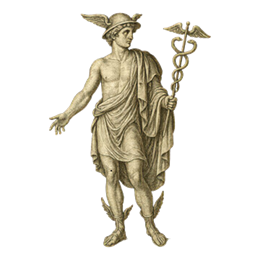
Hermes Mercurius Trismegistus
Hermes (or the Roman Mercury), the archetypal messenger of the gods and the central figure of the Hermetic tradition. In the image above, every garment and accessory he wears carries a specific, functional meaning regarding the mechanics of Consciousness and Universal Law.
The Chlamys (The Traveler’s Cloak)
The flowing garment draped across his body is a traditional Greek traveler's cloak, known as a chlamys. In Esoteric philosophy, clothing is rarely just apparel; it represents that which covers or houses the invisible.
The Veil of Matter: Garments symbolize the physical, astral, and mental bodies that "clothe" the pure, unmanifested Spirit (the Monad). The cloak represents the necessary covering of matter that allows the Divine Spark to interact with the lower planes of existence. Just as absolute Truth is often veiled in allegory and symbol so as not to blind the uninitiated, the cloak veils the "nakedness" of Pure Spiritual Reality.
The Auric Field: The flowing, asymmetrical drape of the garment visually echoes the human aura or the astral body. It represents the dynamic, protective Energy Field that surrounds the physical form—the Energetic boundary or "Ring Pass Not" that the initiate must learn to Consciously manage and purify.
The Caduceus (The Wand of Power)
While technically an accessory rather than a garment, the staff in his left hand is the most vital component of his symbolism. It is a complete map of Esoteric anatomy and Hermetic Law.
The Central Staff: The upright rod represents the central axis of the Universe (Axis Mundi). In the human Microcosm, it represents the spinal column (the Sushumna in Eastern traditions). It is the pillar of Spiritual equilibrium and the direct path of ascent.
The Intertwined Serpents: The two snakes represent the Hermetic Law of Polarity and the Law of Gender. They symbolize the dual, opposing currents of the Universe: the active/masculine (solar) and passive/feminine (lunar) Energies (often referred to as Ida and Pingala). Their intertwining path represents the alchemical process of harmonizing these dual Forces as they rise through the lower centers of the body.
The Wings of Liberation: Resting at the pinnacle of the staff, the wings signify the Ultimate Transmutation. When the dual, serpentine energies of the lower self are perfectly balanced and raised to the Highest Center of the Mind, Consciousness is liberated. It is the visual representation of the Magnum Opus (the Great Work) completed.
The Winged Hat (The Petasos)
Exoterically, the winged helmet represents the messenger's swiftness. However, in the Esoteric study of Mind and Spirit, the wings positioned at the crown of the head symbolize the Higher Mind and the Hermetic Principle of Mentalism.
Connection to the Universal Mind: The wings represent the liberation of Thought from the dense constraints of the physical brain. They signify an intellect that has taken flight, capable of piercing the veil of the material plane to access the noumenal realm and receive direct Gnosis (Divine Wisdom).
Elevated Consciousness: The hat denotes the Conscious observer who operates from the Highest Centers of Awareness. It is the mark of an individual who has aligned their personal, Focused Thought with the perfect order of the Universal Mind, transcending the static and noise of lower, mechanical impulses.
The Winged Sandals (The Talaria)
While the hat governs the realm of Thought, the winged sandals govern the realm of Action, the physical body, and the Hermetic Principle of Vibration.
Mastery Over Matter: The feet touch the earth, representing the foundation of our interaction with the physical plane. Wings on the feet symbolize the ability to walk through the material world without becoming ensnared by its density. It is the Conscious capacity to Live in the physical world while executing earthly duties, without becoming Spiritually bound by it.
Elevated Frequency: The wings suggest a perpetual state of Spiritual buoyancy. By intentionally raising the frequency of the lower self (the physical and emotional centers), one can move swiftly and effortlessly through the necessary trials of physical existence, maintaining a higher vibration regardless of external circumstances.
The Synthesis: Bridging the Poles
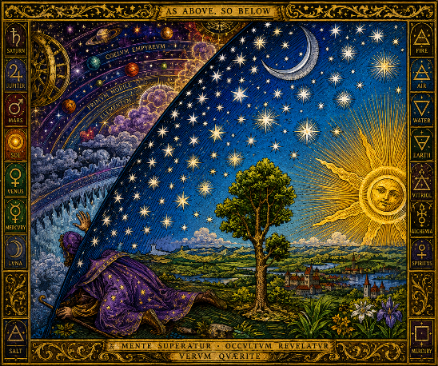
Together, the winged hat and winged sandals visually represent the active union of the Macrocosm (As Above) and the Microcosm (So Below).
Hermes serves as the psychopomp - the eternal bridge between the Divine and the mortal. The presence of wings at the absolute Highest Point of the body (the head) and the absolute lowest point (the feet) illustrates that the Spiritual and the physical are not inherently separate. Instead, they are simply opposite poles of the same continuous spectrum, fully harmonized and vibrating in perfect alignment within the fully realized human being.
Trismegistus comes from the ancient Greek Trismégistos, meaning "Thrice-Greatest". It is an honorific title given to Hermes Mercurius Trismegistus, a legendary, mythical figure who synthesized the Greek god of Wisdom and communication (Hermes) with the ancient Egyptian god of Knowledge and Writing (Thoth).
Why "Thrice-Great"?
The title "Thrice-Greatest" comes from an ancient Egyptian habit of repeating an adjective to denote the superlative degree (e.g., "great, great, great" means "the greatest"). Historically, it is attributed to him in three distinct ways:
The Three Roles: He was revered as the greatest of all Philosophers, the greatest of all Priests, and the greatest of all Kings.
The Three Realms: His Wisdom spanned all three realms of Existence: the Physical, the Spiritual, and the Mental.
The Trinity: He is sometimes credited for being the first to understand the three aspects of the Divine nature (similar to the concept of a Holy Trinity).
Who is Hermes Trismegistus?
In Esoteric traditions, he was not just a Deity, but an ancient sage, prophet, or wise king who lived in Egypt before the great biblical flood. He is celebrated as the purported author of the Hermetica (a foundational collection of texts that includes the Corpus Hermeticum).
Cultural Significance
His name has become synonymous with Occult, Esoteric, and Alchemical Wisdom.
Hermeticism: The Philosophical and Spiritual traditions based on his teachings, which emphasize the Interconnectedness of the Universe, Astrology, Alchemy, and "As above, so below."
Alchemy: Early Alchemists and scientists studied his writings, seeking the secrets of the Universe and the Philosopher's Stone.
Islamic Tradition: He is often equated with the Islamic prophet Idris, known as the first man to write, invent science, and practice Alchemy.