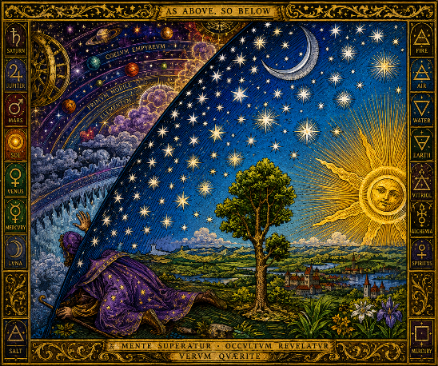
God is ALL in All
This is a Philosophical and Spiritual endeavor to extract, Harmonize, and synthesize the Universal Truths underlying the world's Diverse Religious, Mystical, and Philosophical traditions. Most famously associated with the concept of Perennial Philosophy, it posits that All Major Traditions share a single, transcendent metaphysical Source and Core Set of Truths.
"By the Power of Truth, I, while Living, have Conquered the Universe."
"I Am Nothing, yet I Am Everything."
Guile — The Mask of Deception
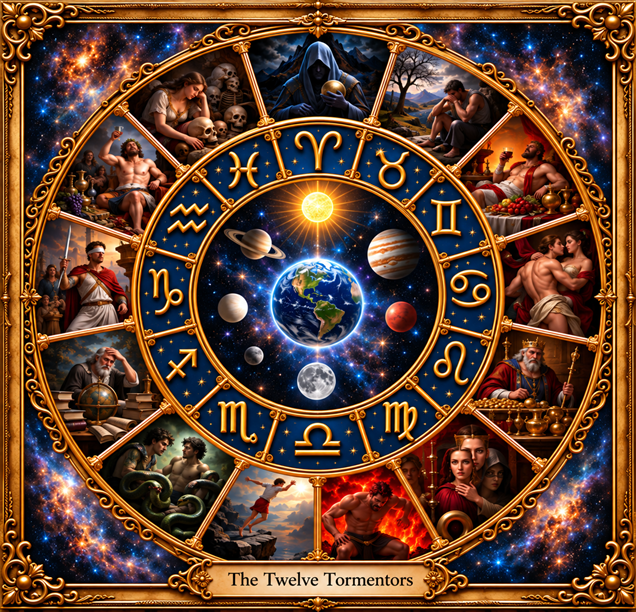
Continuing clockwise around the illustration, we encounter a scene depicting three individuals whose expressions, positions, and relationships suggest an atmosphere of secrecy, uncertainty, and concealed intentions. A woman occupies the foreground, while a man stands closely behind her with his hand resting near her shoulder and neck. A second woman appears partially concealed in the shadows, observing the scene from behind. Their arrangement creates uncertainty about their relationships and intentions, inviting the observer to question what may be taking place beneath their outward appearances.
Unlike some of the preceding Tormentors, whose symbolism is immediately recognizable, Guile presents a more subtle and complicated condition of the human Soul. The figures do not openly display hostility, violence, or greed. Instead, their arrangement creates uncertainty about their relationships and intentions. The woman in the foreground appears prominently illuminated, while the second woman remains partially obscured. The contrast between light and shadow suggests the distinction between what is openly presented and what remains concealed. Yet the illuminated figure is not necessarily truthful, nor is the shadowed figure necessarily deceptive. The image deliberately leaves these questions unanswered, reminding us that appearances alone cannot reliably reveal the intentions of another person. The man's gesture introduces another element of ambiguity. His hand near the foreground woman's shoulder and neck might suggest affection, reassurance, possession, or manipulation. Without knowing his intentions, the observer cannot determine the true nature of the relationship. This uncertainty reflects one of the defining characteristics of Guile: the difficulty of distinguishing genuine intentions from carefully constructed appearances.
In Corpus Hermeticum XIII, Guile is identified among the Twelve Tormentors associated with the Unregenerated human condition. In our Philosophical interpretation, it represents the influence of deception upon Consciousness, through which appearances may be mistaken for reality and falsehood may obscure the recognition of Truth. Guile is more than the occasional telling of a lie. It involves the deliberate manipulation of appearances, words, actions, or circumstances to create an impression that does not correspond to reality. A person governed by Guile may present affection while concealing selfish intentions, offer friendship while pursuing personal advantage, or profess honesty while deliberately withholding information necessary for another person's understanding. Deception may also operate through carefully selected truths. An individual can communicate statements that are technically accurate while arranging or omitting information in such a way that another person is led toward a false conclusion. In this sense, Guile does not always depend upon an obvious falsehood. Sometimes the most effective deception is accomplished through the manipulation of what others are permitted to see.
There is also an important distinction between privacy and deceit. Every individual possesses thoughts, feelings, and experiences that need not be disclosed to others. Maintaining personal boundaries does not constitute dishonesty, nor does the refusal to reveal private information necessarily indicate deceptive intentions. Guile arises when concealment is deliberately employed to mislead, exploit, or manipulate another person. The essential distinction lies not merely in whether information is withheld, but in the intention behind its concealment and the false impression that may be created. The three figures in the illustration may therefore be understood as representing the uncertainty that develops when trust is compromised. One person may be deceiving another, two may be concealing something from the third, or the apparent relationships may differ entirely from what the observer initially assumes. The image does not reveal who is responsible for the deception, and that uncertainty is philosophically significant. It reminds us that outward appearances do not always reveal Inward intentions, and that the observer must exercise discernment before accepting appearances as Truth.
Guile also possesses an Inward dimension that may be even more difficult to recognize: Self-Deception. An individual may construct explanations that justify questionable actions, conceal uncomfortable motives, or preserve a flattering image of personal character. Over time, these explanations may become so familiar that the individual no longer recognizes the difference between genuine Self-Understanding and the stories created to avoid confronting the Truth. In such circumstances, deception no longer operates solely between individuals. It becomes a veil through which Consciousness perceives itself. This condition is especially significant within the Hermetic understanding of Spiritual Regeneration. If the Soul is to Recognize its Higher nature, it must first become capable of perceiving its Own Condition without distortion. A Consciousness governed by false appearances cannot easily distinguish Spiritual Understanding from comforting illusion. The individual may sincerely believe that personal motives are pure while remaining unaware of the fears, ambitions, or desires that influence thought and action. Recognition of Guile therefore requires more than suspicion of others; it requires the courage to Examine Oneself with Sincerity and Discernment.
Among the Ten Divine Powers described in Corpus Hermeticum XIII is Truth, which provides a meaningful contrast to the influence of Guile. Truth represents more than the avoidance of deliberate falsehood. Within our philosophical interpretation, it involves Sincerity, Clarity of Perception, Honest Self-Examination, and the willingness to recognize reality even when that recognition challenges personal desires or cherished beliefs. The Awakening of Truth therefore requires more than learning to speak honestly to others. It also involves the courage to examine One's Own Motives, acknowledge mistakes, and abandon the illusions through which the ego protects itself.
The three figures in the illustration remind us that outward appearances do not always reveal Inward intentions. Their uncertain relationships invite the observer to consider how easily trust can be manipulated and how difficult it may become to recognize deception once it has been accepted as Truth. Ultimately, Guile represents a Soul that has become entangled in the manipulation of appearances, whether through deceiving others, deceiving itself, or both. The lesson of Guile is that Spiritual Understanding cannot flourish where falsehood is deliberately cultivated. The Recognition of Divine Truth begins with the willingness to see clearly, speak sincerely, and Confront the Reality of One's Own Condition.
Deception Conceals
the Truth from others;
Self-Deception Conceals
it from the Soul itself.