God is ALL in All
This is a Philosophical and Spiritual endeavor to extract, Harmonize, and synthesize the Universal Truths underlying the world's Diverse Religious, Mystical, and Philosophical traditions. Most famously associated with the concept of Perennial Philosophy, it posits that All Major Traditions share a single, transcendent metaphysical Source and Core Set of Truths.
"By the Power of Truth, I, while Living, have Conquered the Universe."
"I Am Nothing, yet I Am Everything."
The Good — The Conscious Expression of Divine Goodness
The Divine Power of the Good
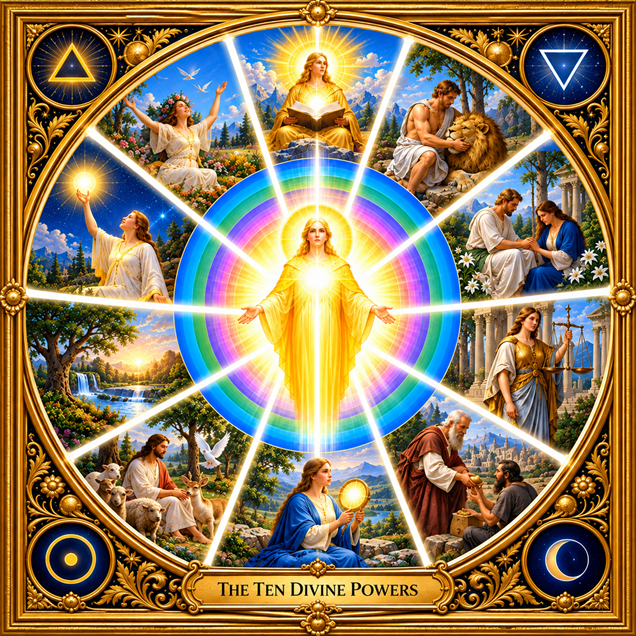
The Good is one of the Ten Divine Powers revealed in Corpus Hermeticum XIII, The Secret Sermon on the Mountain. In the Hermetic account of Spiritual Regeneration, the Good displaces the tormenting influence of Envy, Transforming the individual's relationship with the Welfare, Happiness, and Spiritual development of others. Within Hermetic philosophy, the Good possesses a significance greater than ordinary moral approval. It represents the Divine Principle of Goodness, understood as inseparable from the Ultimate Source of Life, Intelligence, and Being. To become receptive to this Power is to develop a Consciousness increasingly governed by Benevolence, Compassion, and the Recognition of the Good beyond personal advantage.
The distinction between doing good and becoming Good is fundamental to Spiritual Regeneration. Beneficial actions may arise from social expectations, personal ambition, fear of consequences, or the desire for recognition. Although such actions may still help others, their motives do not necessarily indicate Inner Transformation. The Divine Power of the Good develops when constructive conduct becomes the natural expression of Awakened Understanding. The individual no longer requires an external reward to act with kindness or fairness, because Goodness is increasingly recognized as an essential quality of the Spiritual Nature.
The Symbolism of the Compassionate Man and the Animals
Our illustration depicts a compassionate man surrounded by animals in a peaceful natural setting. His gentle presence symbolizes a Consciousness that approaches Living creatures without unnecessary fear, aggression, or the desire to dominate. The animals represent the diversity of Life and the interdependence of beings within Nature. Their apparent trust suggests a relationship established through patience, respect, and harmless intention. The man does not stand apart from Nature as an isolated authority; he participates within it, recognizing that Life possesses significance beyond its usefulness to human interests.
The scene also symbolizes the Harmonious relationship between Spiritual Understanding and the instinctive forces of existence. Animals act according to their natural faculties, while the human being possesses the additional responsibility of Conscious moral discernment. Through Wisdom, strength may become protective rather than destructive, and authority may be exercised through care rather than exploitation. The peaceful gathering therefore represents more than affection for animals. It expresses the ideal of a Regenerated Soul whose conduct contributes to Harmony among the various expressions of Life.
Envy and the Separation of Consciousness
Among the Twelve Tormentors, Envy represents the condition in which another person's happiness, abilities, possessions, or accomplishments become sources of personal dissatisfaction. Its influence arises from the habit of measuring one's worth through comparison. Rather than appreciating the Good present in another's Life, the envious individual experiences that Good as a threat to personal importance. Such thinking may produce resentment, hostility, destructive competition, or the desire to diminish what another has achieved. Envy thus distorts perception by converting another person's success into an imagined personal loss.
The deeper Spiritual difficulty of Envy lies in its reinforcement of separateness. When Consciousness is governed by rivalry, the individual becomes less capable of recognizing shared interests, mutual dependence, and the value of another's development. The Good reverses this tendency by encouraging genuine appreciation of the welfare and accomplishments of others. Their happiness need not diminish one's own, and their Knowledge or abilities may become opportunities for cooperation and learning. As Envy loses its authority, Compassion and goodwill become possible without the continual interference of comparison.
The Good as a Divine Principle
In Hermetic philosophy, the Good is closely associated with God as the Ultimate Source of Being. This understanding differs from the ordinary use of the word good to describe something pleasant, useful, or personally desirable. What benefits one individual temporarily may harm another, while what appears difficult or unpleasant may contribute to greater Understanding and Spiritual development. The Good, considered as a Divine Principle, cannot therefore be reduced to personal preference or immediate gratification. It concerns a deeper order of Reality in which Wisdom, Truth, and the fulfillment of Life are understood as fundamentally related.
This philosophical distinction encourages the individual to examine the difference between apparent benefit and genuine Goodness. Wealth may provide opportunities for constructive action or become an instrument of exploitation. Knowledge may illuminate the Mind or be employed to deceive. Power may protect the vulnerable or serve selfish ambition. The moral character of these faculties depends upon the Understanding and intention directing their use. Recognition of the Good establishes a Higher standard by which human abilities are evaluated, requiring that their exercise contribute to Harmony, Responsibility, and the Welfare of Life.
Compassion and the Recognition of Life
Compassion develops through the Recognition that other beings possess needs, vulnerabilities, and forms of experience deserving consideration. In human relationships, this Recognition encourages patience, understanding, and the willingness to assist without demanding personal advantage. In the natural world, it encourages respect for Living creatures and responsible treatment of the environment upon which Life depends. Such consideration does not eliminate the practical necessities of physical existence, nor does it suggest that every Living being has identical needs. It requires thoughtful discernment concerning the consequences of human action.
The man surrounded by animals represents this broader Awareness of responsibility. His peaceful relationship with the creatures suggests that Spiritual development should become evident in the manner one treats beings unable to provide material reward or social recognition. Kindness toward the vulnerable, restraint in the exercise of power, and the avoidance of needless suffering are practical expressions of the Good. Compassion becomes especially meaningful when it extends beyond personal affection to those who are unfamiliar, dependent, or incapable of returning the kindness they receive.
Goodness, Wisdom, and Moral Discernment
Good intentions alone do not guarantee beneficial consequences. Assistance offered without Understanding may encourage dependence, while excessive tolerance may permit harmful conduct to continue. The Divine Power of the Good therefore requires Wisdom as well as Compassion. An individual must consider circumstances, responsibilities, and probable consequences before determining how best to act. Sometimes Goodness is expressed through encouragement and generosity; at other times, through honest correction, appropriate boundaries, or the refusal to participate in wrongdoing. The purpose is not merely to appear kind, but to contribute constructively to the conditions of Life.
This relationship between Goodness and discernment prevents Compassion from becoming passive sentiment. Genuine concern may require courage, sacrifice, perseverance, and the willingness to confront injustice. It also requires Humility, because no individual possesses unlimited Understanding of another person's circumstances. The Regenerated Soul learns to act sincerely while remaining willing to reconsider mistaken judgments. Through this union of Wisdom and Compassion, the Good becomes a practical governing principle rather than an abstract ideal admired but seldom expressed.
The Good and Spiritual Regeneration
Within the Hermetic process of Regeneration, the Good represents the Transformation of Envy into Benevolence and the growing Recognition of Divine Goodness as a principle of Conscious Life. Knowledge of God Awakens Understanding; Self-Control establishes Inner authority; Continence refines Desire; Righteousness directs conduct toward Justice; Generosity encourages the willing sharing of resources and Knowledge; and Truth establishes sincerity and fidelity to Reality. The Good gives these developing qualities a unifying moral direction, encouraging their expression for purposes consistent with Compassion, Harmony, and the Welfare of Others.
The compassionate man in our illustration embodies this stage of Inner Transformation. His relationship with the animals suggests a Soul no longer governed by the need to compete, possess, or dominate, but increasingly capable of expressing Wisdom through peaceful and responsible participation in Life. Yet this development remains part of Spiritual Regeneration, not the final Realization of Divine Unity. The Good prepares the Soul for deeper Understanding by Transforming its relationship with the world from one of selfish separation toward Conscious participation in a greater Spiritual Order.
The Good is the Conscious expression of Divine Goodness through Wisdom and Compassion, the Overcoming of Envy and Selfish separation, and the Recognition that the Welfare of Life possesses significance beyond personal advantage.