God is ALL in All
This is a Philosophical and Spiritual endeavor to extract, Harmonize, and synthesize the Universal Truths underlying the world's Diverse Religious, Mystical, and Philosophical traditions. Most famously associated with the concept of Perennial Philosophy, it posits that All Major Traditions share a single, transcendent metaphysical Source and Core Set of Truths.
"By the Power of Truth, I, while Living, have Conquered the Universe."
"I Am Nothing, yet I Am Everything."
Master Glossary of Esoteric, Hermetic & Spiritual Terms
A Guide to the Language of Alchemy, Divine Wisdom, Consciousness, and the Universal Principles of Creation
Introduction
The Spiritual, Philosophical, and Mystical traditions of humanity possess a rich vocabulary through which they explore the Nature of Consciousness, the Origin of Creation, and the relationship between the Individual and the Divine. Many of these terms arise from different historical and cultural traditions, yet they frequently address related questions concerning Existence, Transformation, and the Recognition of Ultimate Reality. This Glossary brings together the foundational concepts encountered throughout the House of Wisdom, providing clear definitions while preserving their deeper Esoteric significance. Where historical teachings and Spiritual interpretations differ, those distinctions are acknowledged. The purpose is not to reduce the Mysteries to words, but to provide the reader with a reliable foundation for understanding the language through which they are expressed.
A
Absolute (The): The Infinite, Eternal, Unconditioned Reality beyond all limitation, division, and Manifestation. Within Non-Dual Philosophy, the Absolute is the Ultimate Reality underlying all Existence, neither created nor destroyed, and independent of the changing conditions of the Manifested Universe.
Adept: An Individual who has attained an advanced degree of Knowledge, Discipline, or Spiritual Mastery within an Esoteric tradition. Within Spiritual Alchemy, the Adept represents one who has cultivated Self-Knowledge, harmonized the complementary Powers of Mind, and learned to apply Spiritual Principles through conscious understanding.
Akasha: A Sanskrit term meaning Space or Ether. In several Indian philosophical traditions, it denotes the Element of Space, while in Theosophy and later Western Esotericism it represents a subtle Universal Medium associated with the underlying Substance of Creation.
Akashic Records: A concept developed prominently in Theosophical and later Esoteric traditions, describing a Universal Record of Events, Thoughts, and Experiences. It is understood spiritually as a repository of Cosmic Memory, although its existence as a literal record has not been scientifically established.
Albedo: The Whitening Stage of the Alchemical Great Work, traditionally associated with Washing, Purification, and the removal of impurities. Within Spiritual Alchemy, it represents the restoration of Inner Clarity following the dissolution symbolized by Nigredo.
Alchemy: A historical tradition combining the study of substances, laboratory operations, Natural Philosophy, and Spiritual or Religious symbolism. Alchemists investigated the Transformation of Matter, the preparation of medicines, and the possibility of metallic Transmutation. Spiritual Alchemy interprets these operations as symbols of the Transformation and refinement of Human Consciousness.
Anthropos: A Greek term meaning Human Being. Within Hermetic and Gnostic traditions, it can refer to the Primordial or Universal Human. In Esoteric symbolism, the Anthropos represents Humanity as a Microcosm reflecting the Principles of the Greater Universe.
Archetype: A fundamental pattern, image, or organizing form recurring within mythology, Religion, symbolism, and Human Experience. In Jungian Psychology, Archetypes are structural tendencies of the Collective Unconscious, expressed through symbolic imagery and recurring themes.
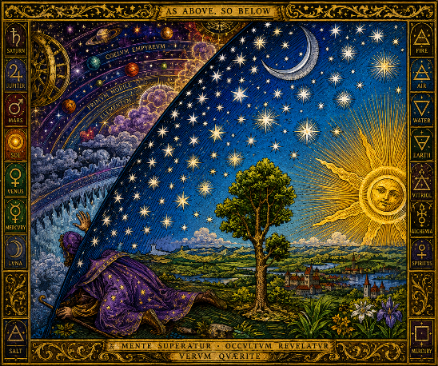
As Above, So Below: A Hermetic expression associated with the Emerald Tablet, conveying Correspondence between different levels of Reality. It expresses the relationship between the Macrocosm and Microcosm, suggesting that patterns reflected in the Greater Universe also appear within the Human Being.
Ascension: The movement toward a Higher State of Spiritual Understanding or Realization. In Christian Theology, Ascension has a particular meaning associated with Christ; within Spiritual Esotericism, it also symbolizes the elevation of Consciousness beyond identification with limiting conditions.
Astral Body: In Theosophical and related Esoteric systems, a subtle vehicle of Consciousness associated with Emotion, Desire, and nonphysical Experience. Its meaning varies among traditions and should not be confused with an anatomically established structure.
Astral Light: A concept in Western Occultism describing a subtle medium believed to preserve and transmit impressions of Thoughts, Events, and Actions. It is particularly associated with Éliphas Lévi and later Esoteric writers.
Atman: In Hindu Philosophy, the innermost Self. In Advaita Vedanta, the True Self is ultimately identical with Brahman, the Absolute Reality. This Recognition forms the foundation of Non-Dual Realization.
B
Brahman: The Ultimate Reality of Hindu Vedantic Philosophy, Infinite and beyond all limiting attributes. In Advaita Vedanta, Brahman alone is Absolutely Real, while the diversity of Manifestation depends upon that underlying Reality.
Buddhi: A Sanskrit term commonly referring to the faculty of Intelligence, Discernment, and Understanding. In Theosophical teachings, Buddhi also denotes a Higher Spiritual Principle associated with Intuition and Spiritual Wisdom.
C
Calcination: An Alchemical operation involving intense Heat, historically used to transform substances through thermal treatment. Spiritually, it symbolizes the burning away of limiting attachments, rigid beliefs, and conditions obstructing greater Understanding.
Caduceus: A Staff entwined by Two Serpents, traditionally associated with Hermes and Mercury. Within Hermetic symbolism, it represents Mediation, Communication, and the relationship between complementary Powers. It is distinct from the single-serpent Rod of Asclepius associated with Medicine.
Chakra: A Sanskrit word meaning Wheel or Circle. Within Yogic and Tantric traditions, Chakras are subtle centers associated with Spiritual Practice, Consciousness, and the movement of Vital Energy. Their number and interpretation vary among traditions.
Coagula: Latin for Coagulate or Bring Together. In Alchemy, it refers to the formation or stabilization of a substance following Dissolution. Spiritually, it represents the establishment of a more Harmonious Condition after Purification and Transformation.
Collective Unconscious: A concept developed by Carl Gustav Jung describing a shared underlying dimension of the Human Psyche containing Archetypal patterns. It is a psychological theory rather than an established Universal field of Consciousness.
Coniunctio: Latin for Conjunction or Union. Within Alchemy, it represents the joining of complementary substances or Principles, frequently symbolized by the Sacred Marriage of Sol and Luna. Spiritually, it expresses the reconciliation of opposing tendencies within a Harmonious Whole.
Conscious Mind: The aspect of Mental Activity associated with present Awareness, Reasoning, Attention, Discernment, and deliberate Thought. Within the Spiritual framework of the House of Wisdom, it represents the directing Power of Mind working in relationship with the Subconscious.
Correspondence (Principle of): The Hermetic understanding that relationships and patterns found within one level of Existence are reflected within others. It is commonly expressed through the relationship between the Macrocosm and Microcosm.
Cosmic Consciousness: A term used in modern Mystical and Spiritual literature to describe an expanded Awareness in which the Individual experiences Unity with the Greater Whole of Existence.
D
Dharma: A Sanskrit term with meanings including Law, Duty, Truth, Teaching, and the Order sustaining Existence. Its interpretation varies among Hindu, Buddhist, Jain, and other Indian traditions.
Divine Spark: A symbolic expression for the Spiritual Essence or Divine Potential within the Individual. Within several Mystical traditions, it represents the Inner Presence through which Humanity participates in the Greater Divine Reality.
Duality: The condition of perceiving or experiencing Reality through apparent opposites, including Light and Darkness, Subject and Object, Spirit and Matter, and Self and Other. Non-Dual Philosophy examines the underlying Unity within which these distinctions arise.
E
Ego: The sense of Individual Identity and the psychological structures through which a person experiences themselves as a separate being. Within Spiritual teachings, the Lower Ego frequently represents identification with limiting beliefs, desires, and attachments. It should not be confused with every psychological use of the term.
Emanation: The unfolding or expression of Reality from an Ultimate Source. In Neoplatonic and several Esoteric systems, the Many arise through successive levels of Existence without exhausting or diminishing their Source.
Emerald Tablet: A short and influential Hermetic-Alchemical text attributed to Hermes Trismegistus. It is especially associated with the Principle of Correspondence and the relationship between the Higher and Lower conditions of Nature.
Enlightenment: A term used for profound Spiritual Awakening or Understanding. Its meaning varies among Buddhist, Hindu, Mystical, and modern Spiritual traditions, but generally concerns the overcoming of Ignorance and the Recognition of a deeper Reality.
Esoteric: From the Greek esoterikos, referring to what is Inner or intended for a particular circle of understanding. Esoteric teachings emphasize deeper, symbolic, contemplative, or initiatory interpretations beyond outward forms.
Etheric Double: Within Theosophical and related systems, a subtle counterpart of the Physical Body associated with Vital Energy and the organization of Life Processes. This is a traditional Esoteric concept rather than an established anatomical structure.
Evolution (Spiritual): The progressive development or unfolding of Consciousness toward greater Awareness, Integration, and Spiritual Understanding. It is distinct from biological evolution, which concerns changes in living populations across generations.
F
Four Elements: Earth, Water, Air, and Fire, the fundamental categories of Classical Natural Philosophy. Within Spiritual Alchemy, they symbolize complementary qualities of Manifestation: Stability, Receptivity, Thought, and Transformative Activity.
G
Gnosis: A Greek term meaning Knowledge, especially direct or experiential Spiritual Understanding. Within Gnostic traditions, Gnosis refers to liberating Knowledge of Divine Reality and the Human Being's relationship to it.
Gnosticism: A modern scholarly category encompassing diverse Religious movements, especially in the early centuries of Christianity, that emphasized Revelatory Knowledge, the Divine Origin of the Spiritual Self, and liberation from Ignorance or cosmic limitation. These movements did not constitute one uniform doctrine.
Great Work (Magnum Opus): The central undertaking of Alchemy, historically associated with the Transformation and perfection of substances, including the pursuit of the Philosopher's Stone. Within Spiritual Alchemy, it symbolizes the Purification, Reconciliation, and Transformation of Consciousness.
H
Hermes Trismegistus: The legendary figure associated with the fusion of the Greek Hermes and Egyptian Thoth. He is traditionally credited with Hermetic writings concerning Divine Knowledge, the Cosmos, the Human Being, and the relationship between Spirit and Nature.
Hermeticism: A collection of Religious, Philosophical, and Esoteric traditions associated with Hermes Trismegistus. Ancient Hermetic writings explore Divine Mind, Cosmic Order, Spiritual Rebirth, and Humanity's relationship with the Divine. Later Hermetic and Hermetic-inspired teachings developed additional Alchemical, Magical, and Philosophical interpretations.
Higher Self: An Esoteric expression for the deeper Spiritual Identity beyond the changing personality. Depending on the tradition, it may refer to the Immortal Soul, Divine Essence, or Awakened Awareness.
I
I AM Presence: Within certain modern Spiritual and New Thought teachings, the Divine Presence understood as the fundamental Reality of Being within the Individual. The expression emphasizes the relationship between Self-Awareness, Divine Identity, and the Creative Power of Consciousness.
Initiation: The process of entering a Spiritual, Mystical, or Esoteric tradition, often through ceremonial instruction or symbolic rites. Spiritually, it can also represent the progressive Awakening of Consciousness through Knowledge, Discipline, and Inner Transformation.
Involution: In certain Esoteric and Theosophical systems, the descent or expression of Spiritual Principles into increasingly differentiated or Material conditions. It is commonly paired with Evolution, representing the corresponding movement toward Spiritual Recognition.
K
Kabbalah: A Jewish Mystical tradition concerned with Divine Reality, Creation, the Hebrew Scriptures, and the relationship between God and the Universe. Its symbolic structures include the Sefirot and the Tree of Life. Later Christian and Hermetic Kabbalah adapted selected concepts within distinct theological and Esoteric frameworks.
Karma: A Sanskrit term meaning Action. In Hindu, Buddhist, and Jain traditions, Karma refers to morally significant Action and its consequences, understood through differing philosophical accounts of Causation, Rebirth, and Liberation.
Kybalion (The): An Esoteric work published in 1908 under the name Three Initiates. It presents Seven Hermetic Principles and has strongly influenced modern Western Esoteric teaching. Although inspired by Hermetic ideas, it should be distinguished historically from the ancient Corpus Hermeticum.
L
Logos: A Greek term meaning Word, Reason, or Rational Principle. In Greek Philosophy, it refers to Reason or Order; in Christian Theology, the Divine Word; and in Esoteric Philosophy, the Creative Intelligence through which the Unmanifested becomes expressed within Manifestation.
Lower Self: The aspect of Individual Experience identified with limiting desires, habits, fears, and attachment to separateness. Within Spiritual Alchemy, its Transformation symbolizes the refinement of Character and the awakening of Higher Awareness.
M
Macrocosm: The Greater Universe or Cosmic Whole. Within Hermetic Philosophy, the Macrocosm represents the Universal Order whose Principles are reflected within the Human Microcosm.
Manifestation: The expression or appearance of something within perceptible or conditioned Existence. Spiritually, it describes the unfolding of Form, Activity, and Experience from an underlying Creative Principle.
Maya: A Sanskrit term with varying meanings across Indian traditions. In Advaita Vedanta, it is associated with the appearance of Multiplicity and the misperception of Ultimate Reality through Ignorance.
Mentalism (Principle of): The first of the Seven Principles presented in The Kybalion, expressing the teaching that the Universe is Mental in Nature. Within the House of Wisdom, it provides a philosophical framework for understanding Mind as First Cause and Manifestation as an expression of Universal Consciousness.
Microcosm: The Smaller World reflecting the Greater Universe. In Hermetic and Esoteric Philosophy, the Human Being is understood as a Microcosm whose constitution symbolically reflects the Principles of the Macrocosm.
Monad: From the Greek monas, meaning Unity or One. In various Philosophical and Esoteric systems, the Monad represents an indivisible Principle of Being. Within Theosophy, it is associated with the Higher Spiritual Essence of the Individual.
Mysticism: Spiritual traditions and practices emphasizing direct Experience, Communion, or Union with Ultimate Reality. Mystical teachings occur across many Religions and Philosophical traditions, although their understandings of that Reality differ.
N
Nigredo: The Blackening Stage of the Alchemical Great Work, associated with Dissolution, Decomposition, and the breakdown of an existing condition. Spiritually, it represents the confrontation and dissolution of limiting patterns before Renewal becomes possible.
Non-Duality: The Philosophical and Spiritual understanding that Ultimate Reality is not fundamentally divided into separate, independent entities. In Advaita Vedanta, this is expressed through the essential Unity of Atman and Brahman. Other Non-Dual traditions offer distinct interpretations.
O
Occultism: From the Latin occultus, meaning Hidden or Concealed. The study or practice of traditions concerned with hidden meanings, subtle relationships, Spiritual Powers, and the unseen dimensions of Nature. The term describes a historical and cultural field rather than an established branch of experimental Science.
Ouroboros: The Serpent or Dragon forming a Circle by consuming its own tail. An ancient symbolic image associated with Cyclic Renewal, Continuity, the Unity of Beginning and End, and the Transformation of Nature.
P
Perennial Philosophy: The philosophical perspective that the world's diverse Religious and Mystical traditions share or point toward an underlying Spiritual Truth. It emphasizes Unity beneath differences while recognizing that traditions retain distinct teachings and historical contexts.
Philosopher's Stone: The legendary goal of many Alchemical traditions, believed capable of transforming base metals into Gold and associated with perfection or medicinal virtues. Within Spiritual Alchemy, it symbolizes the attainment of an integrated and refined condition of Consciousness.
Prima Materia: The First Matter or Original Substance from which Alchemical Transformation begins. Its historical meanings vary, but it commonly represents the unrefined condition containing the potential for Transformation. Spiritually, it symbolizes the Human Nature awaiting Purification and Integration.
Prana: A Sanskrit term referring to Breath, Vitality, or Life Force. In Indian philosophical and Yogic traditions, it describes the Vital Principle associated with Life and its functioning.
Purification: The process of removing impurities or separating what is Essential from what is unnecessary. Within Spiritual Alchemy, it represents the refinement of Thought, Character, and Consciousness.
R
Rebis: An Alchemical image of a Two-Headed or Androgynous Being, often representing the Union of complementary Principles. It symbolizes the Harmonious Reconciliation of Solar and Lunar, Masculine and Feminine, and other apparent opposites.
Reincarnation: The belief that an aspect of Individual Existence undergoes successive lives or rebirths. Its meaning differs among Hindu, Buddhist, Theosophical, and other traditions, particularly regarding whether an enduring Soul is involved.
Rubedo: The Reddening Stage of the Alchemical Great Work, often associated with completion, perfection, and the culmination of Transformation. Spiritually, it represents the establishment of an integrated condition following Dissolution and Purification.
S
Sacred Geometry: The symbolic and philosophical interpretation of Geometric Forms, Proportion, and Number as expressions of Cosmic Order. Circles, Triangles, Squares, and other forms are used to contemplate relationships between Unity, Multiplicity, and Manifestation.
Salt (Alchemical): One of the Three Principles of Paracelsian Alchemy, representing Fixity, Stability, and Form. Within Spiritual Alchemy, Salt symbolizes the enduring Foundation through which Active and Mediating Principles become established.
Separatio: Latin for Separation. An Alchemical operation involving the division of substances or their constituent parts. Spiritually, it symbolizes Discernment, the ability to distinguish the Essential from the Nonessential.
Septenary Law: A Sevenfold model of Reality found in Theosophical and other Esoteric systems. It describes the Human Being and Cosmos through Seven Principles, Planes, or levels of Existence. The exact classifications differ among traditions.
Sefirot: The Ten Divine Emanations or Attributes described in Jewish Kabbalah. Together they form a symbolic structure through which the relationship between the Infinite Divine Reality and Creation is contemplated.
Solve et Coagula: Latin for Dissolve and Coagulate. An Alchemical expression describing the complementary processes of breaking down an existing condition and recombining its constituent Principles into a new Form. Spiritually, it represents Transformation through Purification and Harmonious Integration.
Solutio: An Alchemical operation involving Dissolution, often through a liquid medium. Within Spiritual Alchemy, it symbolizes the dissolution of rigid patterns and the release of limiting conditions.
Sophia: Greek for Wisdom. In Christian, Gnostic, and other Spiritual traditions, Sophia may represent Divine Wisdom, sometimes personified as a Feminine figure. Her meaning varies considerably among traditions.
Spiritual Seeker: An Individual engaged in the pursuit of Spiritual Understanding, Self-Knowledge, and the deeper meaning of Existence. The Seeker explores teachings and practices intended to cultivate Awareness and Recognition of Divine Reality.
Subconscious Mind: Mental Processes occurring outside immediate Conscious Awareness, including aspects of Memory, Habit, Association, and automatic response. Within New Thought and Spiritual interpretations, the Subconscious is also described as a Receptive Power influenced by sustained Mental Impressions.
Sulphur (Alchemical): One of the Three Principles of Paracelsian Alchemy, associated with Combustibility, Activity, and the Fiery Power of Transformation. Spiritually, it represents Will, Desire, and the Active Creative Impulse.
T
The ALL: In The Kybalion, the Infinite and Unknowable Reality underlying the Universe. The teaching describes the Cosmos as existing within the Infinite Mind of The ALL, expressing the Principle of Mentalism.
Theosophy: Literally Divine Wisdom. The term has been used historically for several forms of Mystical Theology and Spiritual Philosophy. Modern Theosophy, especially associated with Helena P. Blavatsky and the Theosophical Society, combines teachings concerning Spiritual Evolution, Karma, Reincarnation, and the Unity of Existence.
Tree of Life: A central symbolic structure in Kabbalah representing the relationship among the Ten Sefirot and the Divine Order. In Hermetic Kabbalah, it has also been adapted as a map of Consciousness, Spiritual Development, and symbolic Correspondences.
Tria Prima: The Three Principles of Paracelsian Alchemy: Sulphur, Mercury, and Salt. They represent complementary qualities associated with Activity, Mediation, and Fixity. Within Spiritual Alchemy, their Harmonious Union expresses the Integration of Spirit, Soul, and Body.
Transmutation: The Transformation of one substance or condition into another. Historically, Alchemical Transmutation included the proposed conversion of base metals into noble metals. Spiritually, it represents the refinement of limiting conditions into greater Awareness and Self-Mastery.
U
Universal Consciousness: The concept of an underlying Awareness or Divine Intelligence encompassing all Existence. Within Non-Dual and modern Spiritual Philosophy, Individual Consciousness is interpreted as an expression of, or inseparable from, this Greater Reality.
Universal Law: A Principle understood to govern the relationships and processes of Existence. In Esoteric teachings, the expression often refers to Spiritual or Metaphysical Principles such as Correspondence, Cause and Effect, and Rhythm, which should be distinguished from empirically established Physical Laws.
V
Vibration (Principle of): One of the Seven Principles described in The Kybalion, expressing the teaching that everything is in Motion or Vibration. Within Esoteric interpretation, it symbolizes differences among states and conditions of Manifestation. Its Metaphysical use should be distinguished from the measurable vibrations studied in Physics.
W
Will (Spiritual): The faculty of deliberate Intention and Direction. Within Spiritual Alchemy, Will represents the disciplined application of Conscious Awareness toward Self-Mastery, Purification, and the Harmonious Expression of Higher Principles.
Z
Zodiac: A system of Twelve Celestial Signs associated with the apparent annual path of the Sun. In Astrology and Esoteric symbolism, the Zodiac represents cycles, qualities, and relationships within the Cosmos. Astrological interpretations are traditional symbolic systems rather than scientifically established causal influences.
Appendix — The Seven Hermetic Principles of The Kybalion
1. Mentalism: The Universe is understood as Mental in Nature, existing within the Infinite Mind of The ALL.
2. Correspondence: Relationships among different levels of Existence are understood through the analogy of the Higher and Lower, the Macrocosm and Microcosm.
3. Vibration: All Manifested conditions are understood as involving Motion or Vibration, with differences of degree and expression.
4. Polarity: Apparent opposites are understood as related extremes of a common underlying Principle.
5. Rhythm: Manifested Existence is understood through recurring Cycles, Movements, and alternating conditions.
6. Cause and Effect: Events and conditions are understood as participating in relationships of Causation rather than arising independently of all conditions.
7. Gender: Creation is symbolically interpreted through complementary Masculine and Feminine Principles, understood as Active and Receptive Powers rather than simply biological sex.
Historical Note: These Seven Principles are presented in The Kybalion (1908). They should not be attributed as a fixed seven-part system to the ancient Corpus Hermeticum.
Appendix — The Principal Stages of the Alchemical Great Work
Nigredo — Blackening: Dissolution, decomposition, and the breaking down of an existing condition.
Albedo — Whitening: Washing, Purification, and the emergence of Clarity.
Citrinitas — Yellowing: Illumination, maturation, and the emergence of Solar Awareness in traditions that distinguish this stage.
Rubedo — Reddening: Completion, Integration, and the attainment of the perfected condition.
These stages provide one influential symbolic framework, although historical Alchemical authors did not all use the same sequence or interpretation.
Closing Reflection
The language of Esoteric Philosophy provides a means of contemplating the relationship between Consciousness, Nature, and the Divine. Alchemy speaks through Transformation, Hermeticism through Correspondence, Mysticism through Direct Realization, and Non-Dual Philosophy through the Recognition of Ultimate Unity. Their teachings are not historically identical, yet each offers a distinct approach to questions concerning the Origin, Nature, and Meaning of Existence. The purpose of this Glossary is to make these traditions more accessible while preserving the richness of their individual expressions. Words provide the foundation for Understanding, but the deeper work remains the cultivation of Discernment, Self-Knowledge, and the Recognition of the ONE within the Many.
Master Glossary of Esoteric, Hermetic & Spiritual Terms downloadable PDF