
God is ALL in All
This is a Philosophical and Spiritual endeavor to extract, Harmonize, and synthesize the Universal Truths underlying the world's Diverse Religious, Mystical, and Philosophical traditions. Most famously associated with the concept of Perennial Philosophy, it posits that All Major Traditions share a single, transcendent metaphysical Source and Core Set of Truths.
"By the Power of Truth, I, while Living, have Conquered the Universe."
"I Am Nothing, yet I Am Everything."
Generosity — The Spiritual Freedom of Giving
The Divine Power of Generosity
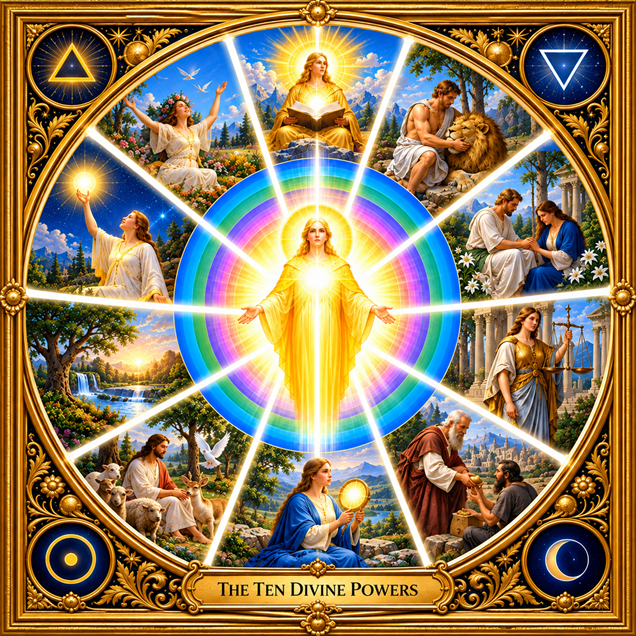
Generosity is one of the Ten Divine Powers revealed in Corpus Hermeticum XIII, The Secret Sermon on the Mountain. In the Hermetic account of Spiritual Regeneration, Generosity displaces the tormenting influence of Covetousness, Transforming the individual's relationship with possession, personal advantage, and the needs of others.
Covetousness arises from the desire to acquire, possess, or retain beyond what is reasonably necessary. Generosity expresses a different orientation of Consciousness: the Recognition that material resources, Knowledge, Abilities, and Opportunities may serve purposes greater than personal accumulation. Generosity does not require the rejection of possessions or the abandonment of personal responsibility. It requires freedom from the attachment that makes possession an end in itself. The Generous individual Recognizes that what one possesses may be valuable not only for what it provides personally, but also for the Good it can accomplish.
The Symbolism of the Elderly Man Giving
Our illustration depicts an elderly man offering something to another person. His age symbolizes experience, reflection, and the Wisdom that may develop through a Lifetime of Learning. The act of giving represents the voluntary sharing of something valuable. Whether the gift is material assistance, Knowledge, or an expression of kindness, its Spiritual significance lies in the intention to benefit another.
The elderly figure also suggests an important relationship between Wisdom and Generosity. Experience may teach that possessions are temporary, while the beneficial influence of an act can extend beyond the immediate circumstances in which it occurs. The recipient represents the interdependence of human Life. Every individual, regardless of personal achievement or material circumstances, depends upon the contributions of others. The exchange therefore symbolizes more than charity. It expresses the Recognition that Life is sustained through relationships of mutual assistance, cooperation, and care. True Generosity does not diminish the dignity of the receiver or establish the superiority of the giver.
Covetousness and the Illusion of Possession
Among the Twelve Tormentors, Covetousness represents the condition in which the desire to acquire and retain becomes a governing influence upon the Mind. Its expression is not limited to wealth. Individuals may covet recognition, influence, status, authority, or the possessions and accomplishments of others. The underlying difficulty is attachment. When personal identity and security become dependent upon accumulation, the individual may experience continual dissatisfaction regardless of what has already been obtained.
Covetousness can also distort relationships. Others may be evaluated according to their usefulness, viewed as competitors, or regarded as obstacles to personal advancement. Such attitudes narrow Consciousness by directing attention toward acquisition rather than Understanding, cooperation, and the common Good. Generosity reverses this tendency. It weakens the illusion that personal fulfillment depends upon possessing more and encourages the discovery of value in contributing to Life beyond oneself.
The Relationship Between Giving and Inner Freedom
An individual who cannot willingly part with anything may discover that possessions exercise considerable authority over the Mind. Generosity provides a practical means of examining that attachment. The ability to share without resentment, assist without demanding repayment, and give without seeking recognition demonstrates a degree of Inner freedom. Yet genuine Generosity must be guided by Wisdom. Reckless giving that neglects legitimate responsibilities or creates unnecessary dependence does not necessarily serve the Good.
Discernment considers the circumstances of both giver and receiver. Sometimes material assistance is appropriate; at other times, encouragement, education, honest guidance, or an opportunity for greater independence may provide a more lasting benefit. The essential principle is that giving should arise from sincere concern rather than vanity, obligation, or the desire to exercise control. Generosity is most complete when the gift serves another without becoming an instrument of personal advantage.
The Generosity of Knowledge and Wisdom
Among the most valuable gifts one individual can offer another are Knowledge, Understanding, and the opportunity for personal development. Material possessions may be consumed or exhausted through use. Knowledge, however, can often be shared without diminishing what the giver possesses. A teacher who communicates an important principle does not lose that Understanding. A person who shares the benefit of experience may help another avoid unnecessary suffering or discover possibilities previously unrecognized.
Nevertheless, Knowledge must be offered with respect for the recipient's freedom and capacity for Understanding. Wisdom cannot be imposed through argument or authority. Each individual must examine, comprehend, and ultimately apply what has been received. This makes the sharing of Knowledge an especially meaningful expression of Generosity. Its purpose is not to produce unquestioning agreement, but to encourage the development of independent Understanding. The greatest value of such giving may appear long after the original exchange, when Knowledge becomes practical Wisdom in another person's Life.
Compassion, Humility, and the Common Good
Generosity finds its Higher expression when Compassion is joined with Humility. Compassion recognizes the needs and difficulties of others. Humility prevents the giver from interpreting assistance as evidence of personal superiority. A Generous act may be quiet and unnoticed. Its worth does not depend upon public acknowledgment or the gratitude of its recipient.
This principle also extends beyond individual charity. Fair dealing, the responsible use of resources, the sharing of opportunities, and contributions to the welfare of a community are expressions of Generosity when motivated by sincere concern for the Good. The individual who develops this Power begins to regard personal abilities and resources as opportunities for constructive participation in the greater Life of humanity. Generosity thus becomes a practical expression of Spiritual Understanding through Compassionate action.
Generosity and Spiritual Regeneration
Within the Hermetic process of Regeneration, Generosity represents the Transformation of possessiveness into willing participation in the welfare of others. Knowledge of God Awakens Spiritual Understanding. Self-Control establishes Inner authority. Continence refines Desire. Righteousness directs conduct toward Justice and Integrity. Generosity extends these developing qualities into the active expression of Compassion.
The elderly man in our illustration embodies this Transformation. His gift symbolizes not merely the transfer of something possessed, but the freedom to place another person's welfare alongside his own. Through Generosity, the Regenerated Soul learns that the value of what one possesses is not measured solely by what can be retained, but also by the Good that can be accomplished through its responsible use.
Generosity is the Conscious expression of Compassion through giving, the freedom to possess without attachment, and the Wisdom to Recognize that what benefits another may also enrich the Spiritual Life of the giver.