
God is ALL in All
This is a Philosophical and Spiritual endeavor to extract, Harmonize, and synthesize the Universal Truths underlying the world's Diverse Religious, Mystical, and Philosophical traditions. Most famously associated with the concept of Perennial Philosophy, it posits that All Major Traditions share a single, transcendent metaphysical Source and Core Set of Truths.
"By the Power of Truth, I, while Living, have Conquered the Universe."
"I Am Nothing, yet I Am Everything."
Error — The Misplacement of Life's Priorities
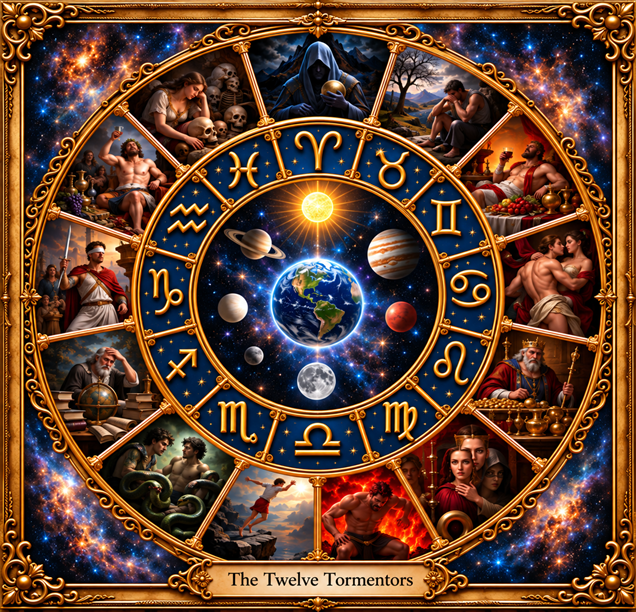
Continuing clockwise around the illustration, we encounter a reclining man surrounded by an abundance of food, fruit, wine, and luxurious possessions. A wreath rests upon his head, and he raises a goblet in apparent celebration. His relaxed posture and satisfied expression suggest an individual enjoying the comforts and pleasures of material existence. Yet behind him, several figures sit quietly, seemingly separated from his celebration. Their presence introduces an important contrast between outward prosperity and the possibility of something more meaningful being overlooked. At first glance, this scene might appear to represent Intemperance, the excessive indulgence of bodily appetites and material pleasures. However, the presence of the background figures invites another interpretation. The man may possess everything necessary to satisfy his immediate desires while remaining unaware that his pursuit of personal gratification has displaced relationships and responsibilities that give Life deeper meaning. The figures are not explicitly identified as members of his family, nor does the illustration establish that he has neglected them. They may nevertheless be understood as representing loved ones, companions, or individuals whose relationships with him deserve greater attention. Their apparent separation from the celebration encourages us to consider the possibility that material abundance and emotional or Spiritual fulfillment are not necessarily the same thing.
In Corpus Hermeticum XIII, Error is identified among the Twelve Tormentors associated with the Unregenerated human condition. The ancient text does not restrict Error to mistaken priorities, and its Spiritual significance extends beyond the particular circumstances depicted in our illustration. Within this study, however, we examine one important expression of Error: the failure to Recognize the relative importance of different aspects of human existence. Error does not necessarily arise from dishonesty, selfishness, or an intention to cause harm. A person may sincerely believe that a particular course of action is right while failing to Recognize that the underlying judgment is mistaken. Likewise, the reclining man's error is not necessarily his enjoyment of food, wine, or material prosperity. These things are not inherently wrong, nor does their possession prevent an individual from developing Spiritual Understanding. The deeper issue concerns the possibility that he has mistaken temporary gratification for the fullness of human existence. Material possessions may provide comfort, security, and opportunities for enjoyment. Personal achievements may bring satisfaction and a sense of accomplishment. Yet neither possessions nor achievements can automatically replace genuine affection, companionship, responsibility, or the Inward Recognition of Spiritual Purpose. When the pursuit of personal pleasure becomes the principal measure of a successful Life, other dimensions of existence may gradually lose their importance. The individual may appear prosperous and content while remaining Unaware of what has been sacrificed in the pursuit of that prosperity.
One of the most subtle characteristics of Error is that mistaken priorities may develop gradually, without any Conscious decision to abandon what is truly valuable. A person may begin with entirely reasonable intentions. The desire to provide financial security, accomplish worthwhile goals, or enjoy the rewards of personal effort may initially serve constructive purposes. Yet circumstances and ambitions can change, and what began as a means of supporting a meaningful Life may eventually become the central purpose around which everything else is arranged. An individual may devote enormous effort to acquiring wealth while neglecting the relationships that wealth was originally intended to support. Another may pursue recognition or personal achievement so relentlessly that little time remains for family, friendship, or reflection. Someone else may become so absorbed in entertainment and immediate gratification that responsibilities and opportunities for personal growth are repeatedly postponed. In each case, the individual may believe that life is progressing successfully while remaining unaware of what is being sacrificed.
A person may believe Life is going wonderfully while remaining Unaware of what is being neglected. This is not necessarily a condition of deliberate wrongdoing. It may arise through a gradual narrowing of attention, in which the individual continues pursuing an objective long after losing sight of the reasons it was originally considered important. The outward signs of success remain visible, but the deeper purpose they were intended to serve has become obscured.
The reclining man's raised goblet becomes especially meaningful within this interpretation. It may symbolize a celebration of what he believes he has achieved. He appears to possess the outward signs of prosperity and satisfaction, yet the image invites us to consider whether those outward conditions necessarily reflect the deeper quality of his existence. The figures in the background introduce the possibility that his Understanding of Fulfillment is incomplete. Their presence does not establish that he has deliberately mistreated or abandoned anyone. Rather, it encourages the viewer to consider how easily personal priorities may become distorted when attention is directed primarily toward immediate rewards. The man may be celebrating a genuine achievement, yet his satisfaction does not necessarily mean that every important aspect of his Life has received the attention it deserves. The scene therefore presents a philosophical question rather than a moral accusation. What does it mean to Live successfully? Is success measured entirely through possessions, pleasures, recognition, and accomplishment, or must it also include the quality of one's relationships, responsibilities, Understanding, and Inner Life? The illustration does not require us to condemn the reclining man. It invites us to examine the assumptions through which we determine what is truly valuable.
There is an important distinction between Error and Intemperance, even though the two scenes share similar outward imagery. Intemperance concerns the excessive indulgence of appetites and pleasures, while Error concerns mistaken Understanding or Judgment. An individual may exercise considerable moderation in personal habits yet still make serious errors in judgment. Conversely, excessive indulgence may result from the mistaken belief that pleasure or material abundance is the Ultimate Source of Happiness. The Two Tormentors may therefore influence one another without being identical. Error is also closely related to Ignorance, which we examined in the preceding scene. Ignorance concerns the Absence of Knowledge or Understanding, while Error involves the acceptance of a mistaken conclusion or the failure to judge circumstances correctly. The reclining man may possess considerable knowledge of worldly affairs and still misunderstand what is most important to his own well-being. His condition illustrates that practical success and genuine Wisdom are not necessarily the same thing. These relationships become especially significant when considering the interconnected nature of the Twelve Tormentors. Desire may influence the individual's judgment about what will provide satisfaction. Avarice may encourage the belief that increasing wealth is the principal purpose of Life. Intemperance may reinforce dependence upon immediate pleasure, while Ignorance may prevent the individual from recognizing the deeper consequences of these choices. Error may then preserve the entire pattern by convincing the individual that nothing needs to change. These connections are interpretive applications of the Hermetic teaching rather than a fixed system of correspondences prescribed in Book XIII.
Yet the Recognition of Error need not become a reason for condemnation or despair. Every individual makes mistaken judgments, and no human life unfolds without decisions that may later be reconsidered. The willingness to acknowledge an Error can become an important expression of Wisdom, because it creates the possibility of Understanding what was previously overlooked. An individual who discovers that important relationships have been neglected may begin restoring them through renewed attention, sincerity, and responsibility. Someone who Recognizes that material ambitions have displaced deeper values may reconsider how time, energy, and resources are employed. Not every consequence can be reversed, but the Recognition of mistaken priorities can become the beginning of meaningful Transformation. This understanding is especially important because Error does not necessarily reveal a permanently flawed character. A mistaken judgment can be corrected, an incomplete understanding can be expanded, and a misplaced priority can be reconsidered. What matters is the Willingness to Examine One's Life Honestly rather than defending every past decision simply because it has already been made.
Within our interpretation of Hermetic Spiritual Regeneration, liberation from Error involves the Awakening of clearer perception and a deeper relationship with Truth and Knowledge of God. These Divine Powers direct Consciousness beyond mistaken appearances toward an Understanding of existence that is not governed solely by temporary desires or material circumstances. This is a philosophical application of the Regenerative teaching rather than a claim that Book XIII assigns one exclusive Divine Power to Error. The Recognition of Divine reality does not require the abandonment of ordinary human responsibilities. Rather, it may inspire a more Harmonious relationship between Spiritual Understanding and daily conduct. Love, Compassion, Honesty, Responsibility, and meaningful companionship can become expressions of a Consciousness increasingly guided by Wisdom rather than immediate gratification.
The reclining man therefore represents a Soul that may have mistaken the outward appearance of prosperity for the deeper fulfillment of existence. His apparent satisfaction contrasts with the possibility that important human relationships have been overlooked, reminding us that the value of Life cannot be measured solely by possessions, pleasures, or personal accomplishments. The lesson of Error is not that enjoyment, prosperity, or achievement must be rejected, but that these things should be understood within a broader recognition of what gives human existence meaning. Wisdom requires more than the ability to obtain what we desire. It also requires the discernment to recognize whether what we desire is truly worthy of the importance we assign to it.
The greatest Error is Not
always choosing what is Wrong,
but failing to Recognize
what is Truly Important.