God is ALL in All
This is a Philosophical and Spiritual endeavor to extract, Harmonize, and synthesize the Universal Truths underlying the world's Diverse Religious, Mystical, and Philosophical traditions. Most famously associated with the concept of Perennial Philosophy, it posits that All Major Traditions share a single, transcendent metaphysical Source and Core Set of Truths.
"By the Power of Truth, I, while Living, have Conquered the Universe."
"I Am Nothing, yet I Am Everything."
An exploration of the foundational dialogues between Hermes Trismegistus and the Supreme Mind, focusing on the cosmogony, the fall of man, and the nature of the soul.
The Divine Pymander (often translated as Poimandres or "The Shepherd of Men") stands as the first and most pivotal tractate of the Corpus Hermeticum. It serves as the master key to Hermetic philosophy, presenting a profound visionary revelation experienced by Hermes Trismegistus during a state of deep meditative trance. In this state, the physical senses are subdued, allowing the higher consciousness to commune directly with the Infinite.
The entity that appears to Hermes introduces itself not as a localized deity, but as the Supreme Universal Mind itself:
"I am Poimandres, the Mind of the Great Lord, the most Mighty and absolute Emperor: I know what thou wouldest have, and I am always present with thee. [...] Hold in thy Mind all thou wouldst Know, and I will teach thee."
What follows is an unparalleled esoteric transmission outlining the birth of the cosmos, the dual nature of humanity, and the ultimate path of spiritual emancipation.
The Hermetic creation story does not begin with physical matter, but with absolute states of consciousness and elemental forces. Pymander grants Hermes a vision of the primeval state of existence. First, there is an infinite, joyous, and radiant Light. Soon after, a terrifying, downward-tending Darkness emerges, coiling like a serpent and transforming into a watery, chaotic nature.
From the Light, a Holy Word (the Logos) descends upon the chaotic waters. This Logos is the structuring principle of the universe, organizing the chaos into the elements of fire, air, water, and earth.
"That Light, said he, is I, thy God, the Mind, prior to Moist Nature which appeared out of Darkness; and the Light-Word that appeared from Mind is Son of God. [...] Learn my meaning by looking at what you yourself have in you; for in you too, the word is son, and the mind is father of the word. They are not separate one from the other; for life is the union of word and mind."
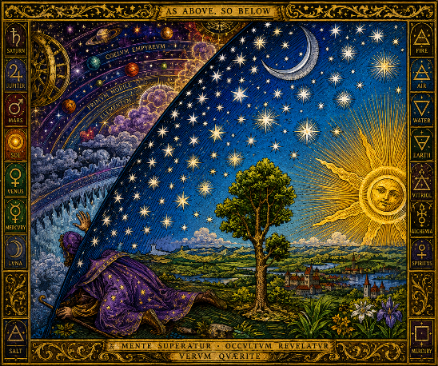
The Supreme Mind, which is bisexual (encompassing both masculine and feminine generative principles), then gives birth to a second Mind—the Demiurge or the Craftsman. This secondary Mind creates the Seven Governors (representing the seven visible planets of ancient astrology), whose harmonious, cyclical orbits enclose the sensory world and govern it through what is known as Destiny or Fate.
Unlike many orthodox religious texts that depict the "fall" of humanity as a punishment for transgression, the Divine Pymander frames the descent of Man as an act of cosmic love and conscious participation.
The Supreme Mind brings forth a creation in Its own image: the Archetypal Man (Anthropos). This being is distinct from the Demiurge; he is exceptionally beautiful, entirely spiritual, and deeply loved by the Father. Given absolute freedom, the Archetypal Man wishes to participate in the creative process and descends through the spheres of the Seven Governors, absorbing their attributes along the way.
Peering down through the cosmic framework, Man sees his own magnificent reflection cast upon the lower world of Nature (matter). Captivated by this reflection, he desires to inhabit it.
"And Nature taking the Lover of her unto her, wholly wrapped herself about him, and they were mingled, for they loved one another. And for this cause, Man above all things that live upon earth is twofold: mortal because of body, but because of the essential Man, immortal."
This union between the eternal Spirit and mutable Nature creates the human condition as we experience it. We are immortal, eternal beings inextricably bound within mortal, transient forms. We are subjected to Fate and the limitations of the physical universe, yet we retain the sovereign, limitless authority of the Supreme Mind within our essential core.
Because of this dual nature, humanity is torn between two worlds. The lower self, driven by the material body and the influences of the planets, is subject to sleep, desire, and mortality. The Higher Self, however, Remains Awake, Eternal, and Divine.
The Divine Pymander explicitly outlines that the Purpose of Life is to Remember this Divine Origin and actively undertake the journey of return. This process of Ascension requires stripping away the accumulated layers of material illusion and planetary influences that the Soul gathered during its descent.
At the moment of physical death, the body is returned to the elements, but the Soul begins a Conscious Ascent Upward through the planetary spheres. At each of the Seven Cosmic Zones, the Soul surrenders a specific lower attribute or vice associated with physical existence:
"And then, with all the energizing of the Harmony stript from him, he cometh to that Nature which belongs unto the Eighth, and there with those-that-are hymneth the Father. [...] This is the good end for those who have gained Gnosis—to be made one with God."
Having shed the heavy garments of the lower ego and material desires, the Purified Soul enters the Ogdoad (the Eighth Sphere). Here, the Individual Consciousness is not extinguished, but rather it Expands to Reunite with the Supreme Mind. This assimilation to Divinity—the Realization that the Individual Mind and the Universal Mind are One and the Same—is the Ultimate Triumph of the Hermetic initiate.