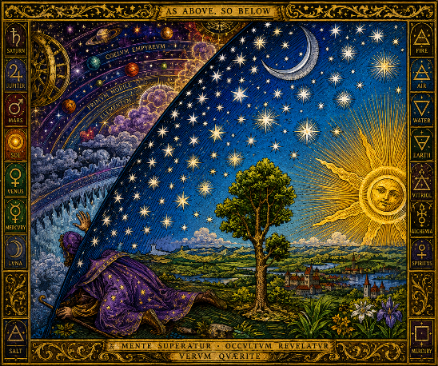
God is ALL in All
This is a Philosophical and Spiritual endeavor to extract, Harmonize, and synthesize the Universal Truths underlying the world's Diverse Religious, Mystical, and Philosophical traditions. Most famously associated with the concept of Perennial Philosophy, it posits that All Major Traditions share a single, transcendent metaphysical Source and Core Set of Truths.
"By the Power of Truth, I, while Living, have Conquered the Universe."
"I Am Nothing, yet I Am Everything."
Dante Alighieri’s Inferno
"For centuries, Dante Alighieri’s Divine Comedy has been read as a Masterpiece of Classic Literature and Orthodox Theology. But beneath the surface of its poetic verses lies a Profound, Hidden Blueprint. This is not just a story of the afterlife—it is a rigorous, geometric map of the Soul’s Initiation. Explore the Esoteric Architecture of Dante’s Universe, where Sacred Numerology, Hermetic Philosophy, and the Ultimate Quest for Divine Wisdom converge."
Dante is a fascinating figure because he stands precisely at the crossroads of Orthodox Theology and Esoteric Philosophy. Within Esoteric and Philosophical traditions, he is best understood as an Initiatic Sage and a Philosophical Mystic.
How He Aligns With Specific Archetypes
The Sage (The Initiate)
To scholars of the Esoteric, the Divine Comedy isn't just a poem—it is a manual of Spiritual Initiation. Dante is widely believed to have belonged to the Fedeli d'Amore (The Faithful of Love), a medieval brotherhood with heavy Hermetic and Templar-adjacent currents. Under the veil of Catholic dogma, his work lays out the Esoteric Architecture of the Soul. Just as the ancient Tabernacle was designed to move from the profane outer courtyard into the Holy of Holies, Dante’s journey maps the Conscious Descent into the lower nature (Hell), the Rigorous Purification of the human faculties (Purgatory), and the Final Ascent into Spiritual Illumination (Paradise).
The Mystic
He was a mystic, but of a Highly Intellectual Order. His Ultimate Destination in the poem is a Direct, Unmediated Experience of the Divine Mind and the Universal Logos. However, his Mysticism didn't involve dissolving into a vague trance; it was about Elevating and Perfectly Aligning the Faculties of the human Mind until they could Perceive the Fierce, Absolute, and Uncompromisable Force of Divine Love that "moves the sun and the other stars."
Not a Magus
Dante was not a practitioner of practical Magic, Alchemy, or Theurgy. In fact, he explicitly placed astrologers, diviners, and sorcerers deep in the eighth circle of Hell. To Dante, the Cosmos operated on Divine Law. Attempting to artificially manipulate those forces for personal power was a perversion of the natural order and an arrogant rebellion against the Divine Will.
Not a mere Dreamer
While the poem is famously framed as a vision (opening with him waking up lost in a dark wood), he was not a passive dreamer. The Inferno is far too mathematically rigorous and hyper-rational to be a dream. Every circle, every punishment, and every syllable of the poem is constructed using Sacred Numerology and Precise Geometry. His Universe is built with the rigid perfection of a Cube and aligned with the unforgiving verticality of a Plumbline. It is a work of Supreme Conscious Architecture, not a wandering reverie.
Ultimately, Dante was a Philosopher-Poet who used dense Allegory and Geometric Symbolism to map the Exact Process of Internal Transmutation—turning the lead of human ignorance into the Gold of Divine Realization.
The Hermetic Architecture of Paradiso
Dante’s entire Cosmological framework is deeply rooted in principles that mirror Hermetic and Theosophical teachings, particularly the relationship between the Macrocosm and the Microcosm. His journey is not just a theological tour; it is a map of Internal Transmutation.
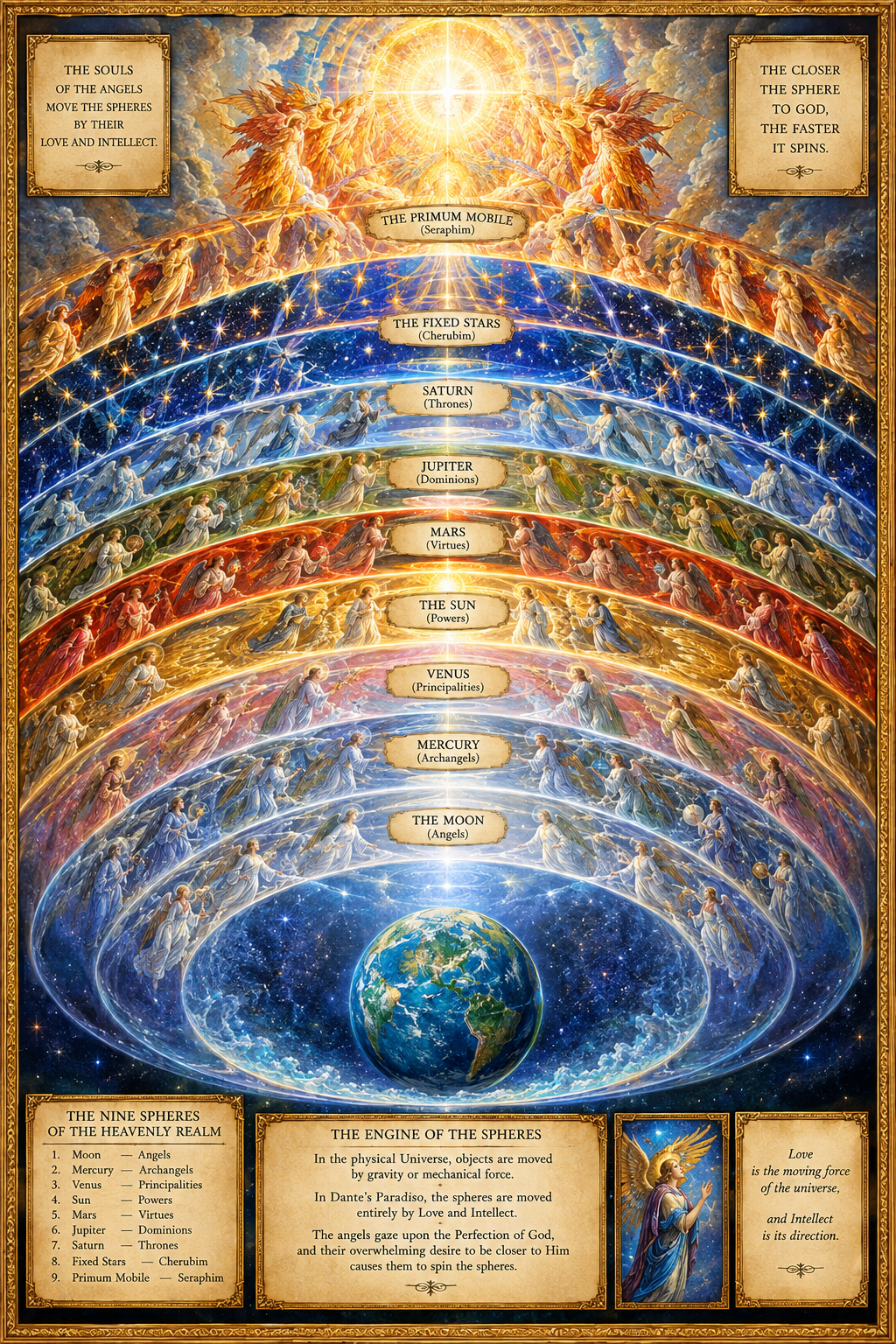
When Dante finally reaches Paradiso, the architecture shifts dramatically. He undertakes a classic Hermetic Ascent through the Ptolemaic Spheres: In Hermetic Thought, the human Soul descends through these exact planetary spheres at birth, taking on the "garments" or specific Psychological Faculties and limitations of each planetary influence. Dante’s Ascent is the deliberate reversal of this process. As he moves from the Moon up to Saturn, he is systematically shedding these earthly faculties and attachments, Purifying the Mind to prepare it for direct contact with the Divine Mind.
Sacred Numerology and Geometry
The Divine Comedy is a Masterwork of Esoteric Geometry. The states of the Soul are mapped to Specific Geometric Realities:
From the Cube to the Sphere
The architecture of Hell is dense, restrictive, and heavy—representing the rigid, material constraints of the Cube. It is a place of Absolute Spiritual Gravity. As Dante Ascends through Purgatory and into Paradise, the geometry softens into Circles and Ultimately expands into Perfect, Boundless Spheres. The Soul is freed from the heavy angles of matter.
The Law of Three and Nine
The entire poem is written in terza rima (interlocking Three-Line stanzas), and the Cosmos is structured in multiples of Three (9 circles of Hell, 9 terraces of Purgatory, 9 spheres of Heaven). Much like the principles underlying the Enneagram, this relentless triadic structure tracks the Soul's Evolution out of fractured multiplicity and back into Profound, Dynamic Unity.
For the Fedeli d'Amore, reading the poem was meant to be an initiatory experience in itself. The geometry and symbols were designed to act as a Plumbline for the reader's Own Soul, Aligning their Internal Faculties with the Uncompromisable Verticality of Divine Truth.
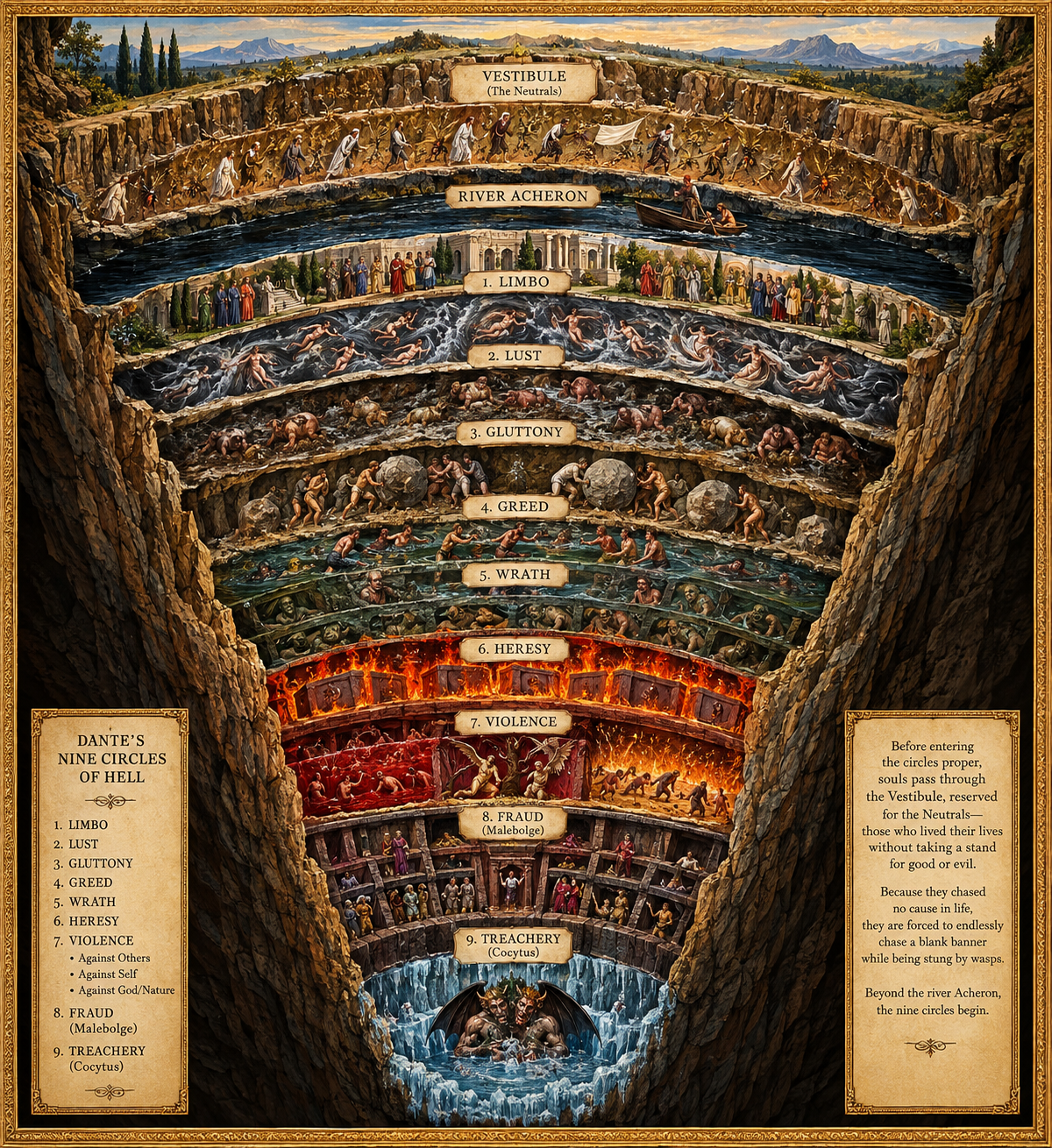
Dante Alighieri’s Inferno is built on a highly structured, geometric framework. He envisions Hell as a massive, inverted cone reaching down to the very center of the Earth. The entire architecture is grounded in Sacred Numerology (revolving heavily around the number 3 and its multiple, 9) and the Philosophical concept of contrapasso—a Law of Poetic Justice where the physical punishment perfectly mirrors or inverts the Psychological nature of the sin.
The Philosophy of the Descent
As you descend deeper into the cavern, the space gets physically tighter, and the sins become morally darker. Dante categorizes human failings into three main types of wrongdoing, largely influenced by Aristotelian ethics:
Incontinence (Lack of Control)
The upper circles (2-5). These are sins of passion and appetite. The intellect wasn't used for evil; it was simply overpowered by primal urges.
Violence
The middle section (Circle 7). Brutality directed outward, inward, or upward.
Fraud and Treachery
The lowest depths (Circles 8-9). This is considered the ultimate corruption because it requires the deliberate misuse of human Intellect—the Divine Faculties of the Mind—to Deceive and Betray.
Dante's Nine Circles
Before entering the circles proper, Souls pass through the Vestibule, reserved for the Neutrals—those who Lived their Lives without taking a stand for good or evil. Because they chased no cause in Life, they are forced to endlessly chase a blank banner while being stung by wasps. Beyond the river Acheron, the Nine Circles begin:
The very bottom of Hell is completely devoid of warmth or light. It is a freezing lake of ice where traitors to special bonds (family, country, guests, lords) are encased. At the dead center is a massive, three-faced Satan, eternally chewing on history's three greatest traitors (Judas, Brutus, and Cassius).
About His Esoteric Brotherhood
The Fedeli d'Amore (Faithful of Love) operated under a strict veil of secrecy during the 13th and 14th centuries, a time when orthodox authorities were fiercely purging anything that resembled heresy. On the surface, this brotherhood appeared to be simply a network of poets writing courtly romantic verses about idealized, unattainable women.
However, to the initiated, this poetry was a highly sophisticated cipher used to transmit Esoteric Philosophy safely:
Amor (Love) was never about earthly romance. It was a code for the Active, Transformative Power of the Holy Spirit, or the Universal Logos—the Divine Intellect that structures the Cosmos.
The "Woman" (such as Dante’s Beatrice or Petrarch’s Laura) was a personification of Sophia—Divine Wisdom. She is the Illuminating Intelligence that greets the initiate and guides them out of the dense ignorance of the material world.
Beatrice is far more than a muse or a memory of a historical Florentine woman. She is a Direct Personification of Sophia, the ancient Hellenistic and Gnostic concept of Divine Wisdom. She represents the Highest, Most Refined State of the Fundamental Faculties of the human Mind—the point where human Intellect becomes capable of Receiving Direct, Unmediated Spiritual Illumination. Her role in the Divine Comedy operates as a precise mechanism for Internal Transformation, Illustrating the limitations of pure logic and the necessity of Spiritual Intuition.
The Handoff of the Faculties: Virgil to Beatrice
The architecture of Dante's journey relies on three distinct guides, each symbolizing a Specific Faculty of Consciousness. The transition between them is not merely a plot device; it is a profound commentary on the Limits of Different Mental States:
Virgil (Human Reason)
Virgil guides Dante through Hell and Purgatory. He represents the peak of unilluminated human logic, moral philosophy, and rational intellect. Reason is absolutely necessary to navigate the dark, heavy geometry of the lower nature—it can categorize sin, understand consequences, and discipline the lower appetites. However, Reason is Ultimately Bound by Time, Space, and the Material World. It can bring a person to the threshold of the Divine, but it cannot enter.
Beatrice (Divine Wisdom/Sophia)
When Dante reaches the top of Mount Purgatory (the Earthly Paradise), Virgil suddenly vanishes. He has taken Dante as far as human logic can go. Beatrice takes over. She represents Theosophia—Divine Knowledge. She is the Intuitive, Illuminated Faculty of the Mind that grasps Universal Truths Directly, without the need for step-by-step rational deduction.
St. Bernard of Clairvaux (Mystical Contemplation)
At the very Highest Sphere of the Empyrean, even Beatrice must step aside. The final vision of the Divine Mind is beyond even Wisdom; it requires Pure, Absolute Mystical Union.
The Descent of the Spark
In Theosophical and Hermetic traditions, there is a recurring motif of Sophia descending from the Higher Realms of Light into the dense, material darkness to rescue the trapped "Sparks" of human Consciousness.
Dante perfectly mirrors this occult framework in the Inferno. Dante is lost in the "dark wood" (a symbol of Spiritual Ignorance and material entanglement), entirely unable to save himself. It is Beatrice who leaves her place in the High Heavens, descends into Limbo, and explicitly commissions Virgil to guide Dante out.
Key insight
The human Intellect (Virgil/Reason) does not spontaneously decide to Seek Spiritual Elevation. The rescue operation is always initiated by Sophia (Divine Wisdom) reaching down to Activate and Direct the rational Mind toward Higher Truth.
The Eyes and the Smile
Throughout Paradiso, Dante’s Ascent through the Hermetic planetary spheres is not achieved by physical movement or mechanical effort. He Ascends solely by gazing into Beatrice's eyes. As they rise from Sphere to Sphere, her Beauty Becomes Increasingly Intense and Blinding. This is a Brilliant Allegory for the Expansion of the human Mind's Faculties:
The Eyes of Beatrice
Represent the Profound, Penetrating Demonstrations of Divine Truth. By locking his Focus on Wisdom, his Own Frequency is Raised, naturally Pulling Him Into Higher States of Being.
The Smile of Beatrice
Represents the Intoxicating Joy and Rapture of Spiritual Realization. In the lower spheres, she must withhold her full smile, warning Dante that his unrefined mortal faculties would be shattered by its Intensity—much like Semele being incinerated by the raw glory of Zeus.
In this way, Beatrice is the Ultimate Initiatrix. She acts as a Transformative Lens, stepping down the Blinding, Uncompromisable Force of the Universal Logos into a Frequency that the developing human Soul can Actually Perceive and Integrate.
The Architecture of Correction: Mount Purgatory
If Hell is a downward cone of Spiritual Gravity, Mount Purgatory is its exact geometric inverse: a towering, conical mountain rising out of the southern ocean, stretching up toward the Celestial Spheres.
While Hell punishes the actions of sin, Purgatory corrects the motivations behind them. To meet Beatrice (Divine Wisdom), the human Mind cannot just stop doing bad things; it must Actively Reprogram its Deeply Ingrained Tendencies and Purify its Will. Dante uses the geometric Ascent of the mountain to map this Psychological Restructuring.
The mountain is divided into Three main sections, mirroring the structural precision of Hell, but oriented toward Healing rather than retribution.
Ante-Purgatory (Overcoming Inertia)
At the base of the mountain, wait the excommunicated, the late repentant, and the lethargic. Esoterically, this represents the heavy, inertial drag of the material world. Before the Mind can even begin Active Purification, it must spend time simply Overcoming its Own Spiritual Laziness and the momentum of a misspent Life.
The Seven Terraces (Recalibrating Love)
Once through the Gate of Purgatory, Dante must climb Seven distinct terraces. Each terrace corresponds to one of the Seven Deadly Sins, which Dante reframes entirely around the concept of Love. To Dante, All sin is simply Love (the Fundamental Driving Force of the Soul) that has malfunctioned. The terraces recalibrate this Force geometrically from the bottom up:
Misdirected Love (The Lowest Terraces): Loving things that cause harm to others. This includes Pride (Desiring Superiority), Envy (Resenting Others' Success), and Wrath (Desiring Revenge). The punishments here Force the Soul to practice the opposing virtue—for example, the proud must carry massive stones on their backs, Forcing them to look downward in Humility.
Deficient Love (The Middle Terrace): Sloth. This is Failing to Love the Good with enough energy or urgency. The Slothful are forced to run constantly without rest, activating their sluggish Spiritual Drive.
Excessive Love (The Highest Terraces): Loving good, worldly things too much. This includes Avarice (money), Gluttony (food), and Lust (flesh). These are placed highest because the object of Love Isn't Inherently Evil, just the Attachment to it.
The Earthly Paradise (The Return to Innocence
At the very peak of the mountain lies the Earthly Paradise (the Garden of Eden). This is a critical esoteric concept: Mount Purgatory does not take Dante to Heaven; it only restores him to the state of perfect, uncorrupted human nature that existed before the Fall. By climbing the mountain, Dante has completely shed the dense, gravity-bound attachments of the ego. Only here, in this State of Absolute Mental Clarity and Purified Will, can Virgil (Human Reason) leave him. Human logic has done its job of restructuring the Psyche. Dante is now a Blank, Perfect Vessel, and it is at this exact geometric summit that Beatrice descends in a chariot of Light to begin his initiation into the Divine Mysteries.
The Two Rivers of Eden
When Dante finally reaches the Earthly Paradise at the summit of Mount Purgatory, the Transition from Purification to Actual Ascension involves a highly specific, ritualistic sequence. He doesn't just sprout wings and fly; his very nature has to be Fundamentally Altered to Survive the Physics of the Celestial Realm.
Before Dante can Ascend, he must undergo a final Psychological Clearing. In Dante's Eden, there are two distinct rivers that serve as the Ultimate Baptism of the Mind:
The River Lethe
First, Dante is submerged in Lethe (the River of Forgetfulness). This washes away all memory of his past sins and the guilt associated with them. The Mind cannot enter the Divine Realms while still burdened by the trauma or shame of its former ignorance.
The River Eunoè
This is a river invented by Dante. After Lethe, he drinks from Eunoè (meaning "Good Mind" or "Good Memory"). This Restores and Strengthens the Memory of Every Good Deed he Ever Performed.
Once he emerges from Eunoè, Dante states he is "Pure and Prepared to Climb unto the Stars." His Consciousness is now entirely frictionless.
The Mechanics of the Ascent: Trasumanar
The actual launch into space is instantaneous and operates on Spiritual gravity rather than physical propulsion. Dante describes the exact moment of liftoff: Beatrice turns her face upward and stares directly into the Sun (representing the Divine Light). Dante, unable to look at the Sun directly, stares fixedly into Beatrice's eyes.
Suddenly, Dante realizes they are hurtling through the atmosphere at unimaginable speed—Faster than Lightning. He is entirely confused about how he is flying without a physical mechanism. Beatrice explains two core concepts:
Spiritual Gravity
In Dante's Cosmos, every object has a natural resting place. Heavy things (like rocks and sinful Souls) naturally fall toward the center of the Earth (Hell). Fire naturally rises toward the sky. Because Dante's Soul has been completely purged of all earthly heaviness and sin, its natural state is now weightless. By the Laws of Divine Physics, his Soul must fall upward toward God, just as a rock must fall downward toward the dirt.
Trasumanar (Transhumanizing)
To survive this, Dante undergoes a process he coins Trasumanar—passing beyond the limits of human nature. His physical body is Transmuted, taking on a Celestial Frequency that allows him to pass straight through the solid, crystalline spheres of the planets like a Ray of Light passing through water without displacing it.
From this moment on, the entire journey through Paradiso is driven by this mirroring process: Beatrice gazes into the Higher Truths of God, and Dante gazes at Beatrice, riding her Illuminated Frequency ever upward.
The Metaphysics of Paradiso
Hell and Purgatory are tangible, terrestrial environments—a subterranean crater and a physical mountain bound by gravity, space, and time. Paradiso, however, abandons earthly physics entirely. Its geometry is metaphysical, constructed strictly from Light, Intellect, and Pure Consciousness.
Where the lower realms are defined by their limitations and heavy borders, the Architecture of Heaven is defined by expansion and transparency.
The Principle of Accommodation (The Divine Hologram)
The most fundamental structural difference in Paradiso is the concept of localization. In Hell, a sinner is literally and eternally trapped in a specific physical ditch; they cannot leave. In Paradiso, no one actually lives on the planets.
When Dante meets Souls in the sphere of the Moon or the sphere of Mars, Beatrice explains a Profound Esoteric Truth: these Souls do not reside there. Every single saved Soul in Heaven actually Lives simultaneously in the Highest Realm, the Empyrean, existing outside of time and space in Direct Communion with God.
However, because Dante is still a mortal man with a finite brain, he cannot comprehend the Absolute, Unfragmented Reality of the Empyrean. To accommodate his limited human faculties, the Divine Mind generates a sort of educational hologram. The Souls project their presence down into the lower planetary spheres as Dante passes through, organizing themselves spatially to show him the degree of their Spiritual Capacity. The spheres are not their prisons or homes; they are just a temporary visual aid for Dante’s benefit.
The Engine of the Spheres
In the physical Universe, objects are moved by gravity or mechanical force. In Dante’s Paradiso, the spheres are moved entirely by Love and Intellect.
According to Dante's medieval Ptolemaic model, the Earth is surrounded by Nine concentric, crystalline spheres (the Moon, Mercury, Venus, the Sun, Mars, Jupiter, Saturn, the Fixed Stars, and the Primum Mobile). These spheres are not made of matter; they are Ethereal.
Each sphere is governed by a specific hierarchy of Angelic Intelligences (from standard Angels up to the Seraphim). The angels continuously gaze at the Perfection of God, and their Overwhelming Desire to be closer to that perfection causes them to spin the spheres. The closer a sphere is to God (like the Primum Mobile), the faster it spins, Driven by the Sheer Intensity of its Spiritual Desire.
The Empyrean: The Geometry of the Infinite
The final geometric shift in Paradiso is a complete spatial inversion. Throughout the entire journey, Dante believes the Earth is the center of the Universe, with the heavens revolving around it. But when he finally pierces through the final material sphere into the Empyrean (the True Heaven), he looks back and Realizes his perspective has been inside-out.
In Reality, God is the Center of Everything—an Infinitely Small, Blindingly Bright Point of Light. The Universe radiates outward from that Divine Point. The Earth is actually the furthest, coldest, and darkest edge of Reality.
In the Empyrean, all geometry ceases to function. Space and Time dissolve entirely into a massive amphitheater of Light shaped like a Pure White Rose (the Rosa Mystica), where All the Souls of history sit in Perfectly Still, Rapturous Contemplation, Absorbing the Universal Logos Directly.
The Architect's Exile
Dante’s exile was the absolute defining trauma of his life, and without it, the Divine Comedy would not exist.
In 1302, he was a high-ranking politician in Florence. While he was away in Rome on a diplomatic mission to the Pope, a rival political faction (the Black Guelphs) violently seized control of Florence. Dante was falsely accused of corruption, heavily fined, and exiled under pain of being burned at the stake if he ever returned. He lost his wealth, his home, his family, and his civic identity in a single stroke, spending the rest of his Life wandering from court to court across Italy.
From an Esoteric and Philosophical perspective, this brutal severing from his earthly attachments acted as a Forced, Profound Initiation. It influenced the poem in three critical ways:
The Catalyst for the "Dark Wood"
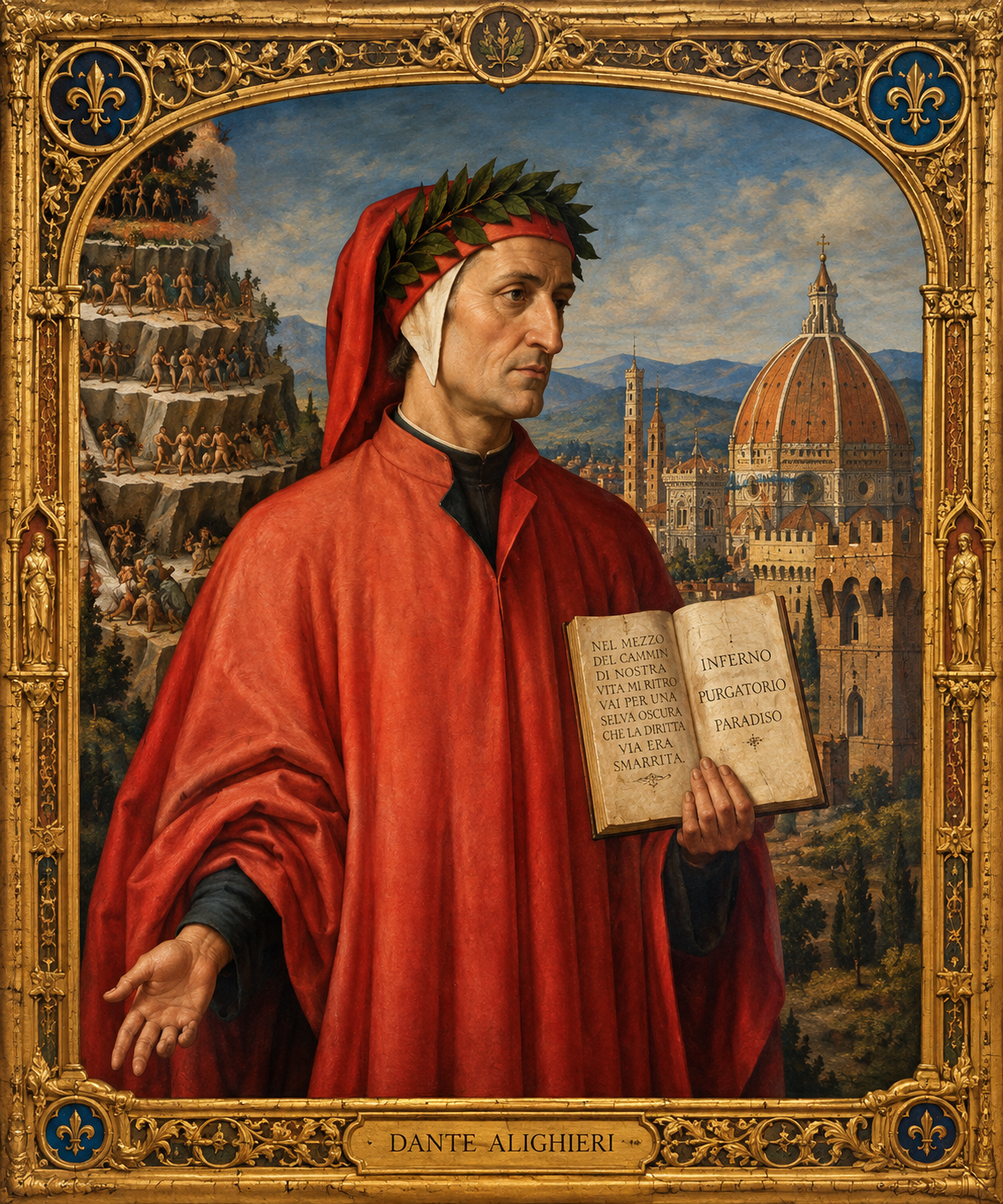
When the Inferno opens with Dante waking up lost in a "dark wood" in the middle of his Life, this is not just a Spiritual metaphor; it is the Literal Reality of his Exile. In Hermetic and Theosophical traditions, the Soul must be violently stripped of its earthly identities, comforts, and ego-attachments before it can perceive Higher Truths. Florence was Dante's entire world and identity. By being cast out of his physical home, he was Forced to Seek a Cosmic One. The exile shifted his perspective from a local Florentine politician to a Universal Sage. He Realized that attaching one's Soul to the shifting, corruptible politics of the material world always leads to the "dark wood."
The Architecture of Absolute Justice
Earthly justice had failed Dante completely. The people who exiled him—and the corrupt Pope Boniface VIII who orchestrated it behind the scenes—were thriving in wealth and power. Because he could find no justice in the material world, Dante used the Divine Comedy to construct a Universe governed by Absolute, Mathematically Perfect Divine Justice. He didn't just write a theological treatise; he weaponized the poem, deliberately placing the very politicians, popes, and aristocratic families who had destroyed his life into highly specific, agonizing circles of Hell. It was an Act of Profound Philosophical Defiance: asserting that the Universal Law outlasts and overrules earthly power.
The Mission of the Prophet
Before his exile, Dante wrote beautiful, but relatively standard, courtly Love poetry. After his exile, he adopted the mantle of a prophet. Because he had lost his earthly citizenship, he claimed citizenship in the Celestial Spheres. He framed his journey not as a personal vision, but as a Divine mandate—Beatrice and the heavens ordered him to travel through the afterlife and report back to a corrupt, fallen humanity to help them correct their course. This is also why he made the radical, subversive choice to write the Comedy in the vernacular Italian dialect rather than the scholarly Latin of the Church. As an exile, he bypassed the corrupt institutional gatekeepers of his day, delivering this massive blueprint of Spiritual Transmutation directly to the people.
The Battle for the Bones
Dante died of malaria in 1321 while returning to Ravenna from a diplomatic mission to Venice. Because his exile from Florence was never lifted during his lifetime, he was buried in his adopted city of Ravenna, right next to the Basilica of San Francesco.
Florence absolutely tried to get his body back—multiple times—leading to a centuries-long, almost comical game of hide-and-seek with his bones. As Dante's fame skyrocketed posthumously, Florence regretted exiling him and realized they were missing out on claiming Italy's greatest poet. They formally requested his remains in 1430 and again in 1476, but Ravenna flatly refused both times.
Then, in 1519, Florence brought out the heavy artillery: Pope Leo X. Because the Pope was a member of the powerful Florentine Medici family, he issued a direct papal decree demanding Ravenna hand over the bones. A Tuscan delegation confidently marched into Ravenna with the Pope's orders, opened the sarcophagus, and found it completely empty. The Franciscan friars of Ravenna, anticipating the raid, had secretly tunneled a hole into the back of the sarcophagus from their adjacent cloister and stolen the bones to keep them out of Florentine hands.
The friars successfully hid Dante's remains for hundreds of years. They sealed them inside a wall to hide them from Napoleon's occupying troops in 1810, and the bones were actually lost until workmen accidentally rediscovered them in a wooden box in 1865. The monks even buried the bones in the garden during World War II to protect them from Allied bombing.
Meanwhile, holding out hope that they would eventually win the standoff, Florence built a massive, glorious monument to Dante in 1829 inside the Basilica of Santa Croce—the church where luminaries like Michelangelo, Machiavelli, and Galileo are buried. Despite their best efforts, Florence never got him back. Their magnificent monument remains an empty cenotaph to this day. Florence has finally accepted defeat, but as a gesture of peace and continued reverence, the city sends a delegation every year in September to provide the Tuscan olive oil that fuels the eternal flame burning inside his tomb in Ravenna.
The Enduring Plumbline
"The battle for Dante’s physical remains is a fittingly earthly coda to a Life that Transcended the material world. Yet, his True legacy is not buried in Ravenna, nor is it an empty tomb in Florence. His legacy is the Divine Comedy itself—an enduring plumbline designed to Align the Human Faculties with Universal Truth. For the modern Seeker willing to look past the medieval dogma, Dante’s journey remains a Timeless, Practical Guide for Transforming the dense lead of human ignorance into the brilliant Gold of Spiritual Illumination."
Dante - The Divine Comedy PDF