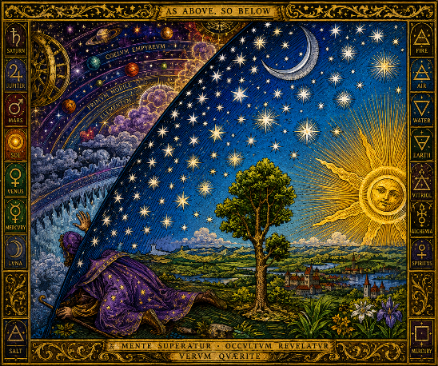
God is ALL in All
This is a Philosophical and Spiritual endeavor to extract, Harmonize, and synthesize the Universal Truths underlying the world's Diverse Religious, Mystical, and Philosophical traditions. Most famously associated with the concept of Perennial Philosophy, it posits that All Major Traditions share a single, transcendent metaphysical Source and Core Set of Truths.
"By the Power of Truth, I, while Living, have Conquered the Universe."
"I Am Nothing, yet I Am Everything."
Babylonian
I. Origins and the Polytheistic System
Babylonian religion was a complex and deeply rooted polytheistic system that evolved over thousands of years among the Sumerian and Semitic peoples of the Tigris and Euphrates valley. It was more than a mere collection of myths; it was a comprehensive way of life centered around the worship of nature gods, the performance of elaborate rituals, and the pervasive use of magic. Throughout its long history of changing empires and shifting political powers, the religion remained steadfast in its devotion to appeasing the divine and securing earthly prosperity, blending high moral conceptions with an enduring belief in sorcery and witchcraft.
II. The Pantheon of the Gods
The central doctrine of the Babylonian faith was the belief in a series of powerful nature gods, completely lacking the conception of one supreme and almighty God. At the head of this pantheon stood a great triad: Anu, the god of heaven; Bel, the god of the earth and of mankind; and Ea, the god of the water abyss beneath the earth. Other prominent deities included Sin, the Moon-god; Shamash, the Sun-god and judge of the world; Ramman, the god of the atmosphere; Marduk, the national god of Babylon; and Ishtar, the goddess of love and battle. While wielding superhuman powers and magical weapons, these gods were conceived in a very material way, possessing human forms and being swayed by human passions, fears, and desires.
III. The Relationship Between the Gods and Humanity
Unlike traditions built upon a mutual covenant of love, the Babylonian relationship with the divine was fundamentally a master-servant dynamic. The gods were the absolute rulers of the universe who had emerged from a primeval watery chaos. Humanity's role was to honor and sustain these deities through strict obedience, the building of magnificent temples, and the continuous provision of offerings. In return, the Babylonians sought the gods' protection against the countless demons, ghosts, and hostile spirits that animated the natural world and constantly threatened mankind.
IV. Sacred Epics and Divine Traditions
Rather than relying on a single book of divine instruction, the Babylonians preserved their theology through great mythological poems and legends. Foremost among these was the "Enuma Elish," the great Creation Series, which detailed how the god Marduk achieved supremacy by slaying the chaos-monster Tiamat and splitting her body to form the heavens and the earth. Other profound texts, such as the Epic of Gilgamesh, contained stories of a great deluge and the heroic search for immortality. These texts served to explain the working of the universe, the origins of life, and the mechanics of the spiritual and physical laws established by the gods.
V. Human Beings Created for Service
Babylonian cosmogony taught that human beings were created as an extension of the divine will, specifically to inhabit the earth and serve the gods. According to the traditions preserved by the historian Berosus, the god Bel directed that his own head be cut off, and the flowing blood was mixed with the earth to fashion men and animals. This divine origin explained both humanity's life force and its subordinate position. Mankind was brought into existence so that the gods might dwell in the habitations of their hearts' desire, making human labor a fundamental aspect of the cosmic order.
VI. Fate, Destiny, and Human Agency
The Babylonians believed that the ultimate fate of the world and of individuals was decreed by the gods, particularly by whomever held the sacred "Tablets of Destiny". While the gods determined life and death, human beings were not entirely powerless; they possessed the agency to influence their circumstances through magical intervention. By reciting the proper incantations, pronouncing spells, and performing specific rituals, a person could invoke the greater gods to alter their fate and deliver them from the baneful influences of evil spirits.
VII. Law, Order, and Righteous Living
Justice and ethical conduct were highly valued in Babylonian thought. The Sun-god, Shamash, was revered as the supreme judge of heaven and earth, to whom individuals appealed in cases of wrong and injustice. Babylonian religious texts reveal a comparatively high moral character, instructing men to be pure of heart, to offer prayer and supplication early in the morning, and to practice mercy. Righteous living required that a person deal fairly with others, as the texts explicitly commanded individuals not to speak evil against their friends and neighbors.
VIII. Appeasement and Propitiation
In Babylonian belief, sickness, misfortune, and plagues were often attributed to the anger of the gods or the malicious attacks of entities like Namtar, the demon of pestilence, or an "ekimmu," a wandering spectre. When afflicted, individuals did not merely seek physical healing but engaged in intense spiritual appeasement. This process involved crying out to deities like Ea, Shamash, and Marduk for deliverance, accompanied by the necessary offerings of meat, drink, and clothing to satisfy the hostile spirit and ensure its departure to the underworld.
IX. Worship Through Temple and Ritual
Babylonian worship was a deeply ingrained daily and civic practice centered in great local sanctuaries, such as E-sagil in Babylon or E-kur in Nippur. The devotion to the gods was heavily tinctured with magic, meaning that formal prayers were often interwoven with charms and spells. Sanctifying life required regular participation in sacrifices, the pouring out of libations, and the observance of great festivals. Even the king played a vital priestly role, ensuring that the temples were built, the gods were fed, and the cosmic order was maintained through precise ceremonial obedience.
X. The Underworld and the Afterlife
The Babylonians held a profoundly joyless view of life beyond the grave. They believed that deep within the earth lay Arallu, the House of the Dead, a dark and gloomy cavern ruled by the goddess Allatu and the god Nergal. In this "land of no return," the deceased received no reward for a virtuous life; all were reduced to the same miserable state, clothed in feathers like birds and forced to eat mud and dust. Because of this bleak prospect, the utmost importance was placed on proper burial rites, for a body left unburied meant the soul would wander the earth endlessly, driven by hunger to eat street offal.
XI. The Goal of Babylonian Life
The ultimate goal of Babylonian religion was to achieve prosperity, health, and success in the present life, while avoiding the wrath of both the gods and the demonic forces of the natural world. Because the afterlife offered no joyous paradise, the faithful Babylonian sought to maximize their earthly existence through strict obedience to divine laws, mastery of protective magic, and reverence for the local deities. Finally, the goal included securing a respectful and proper burial, complete with dedicatory offerings, to guarantee a peaceful, if somber, rest in the eternal gloom of Arallu.