God is ALL in All
This is a Philosophical and Spiritual endeavor to extract, Harmonize, and synthesize the Universal Truths underlying the world's Diverse Religious, Mystical, and Philosophical traditions. Most famously associated with the concept of Perennial Philosophy, it posits that All Major Traditions share a single, transcendent metaphysical Source and Core Set of Truths.
"By the Power of Truth, I, while Living, have Conquered the Universe."
"I Am Nothing, yet I Am Everything."
Anger — The Fire That Consumes the Soul
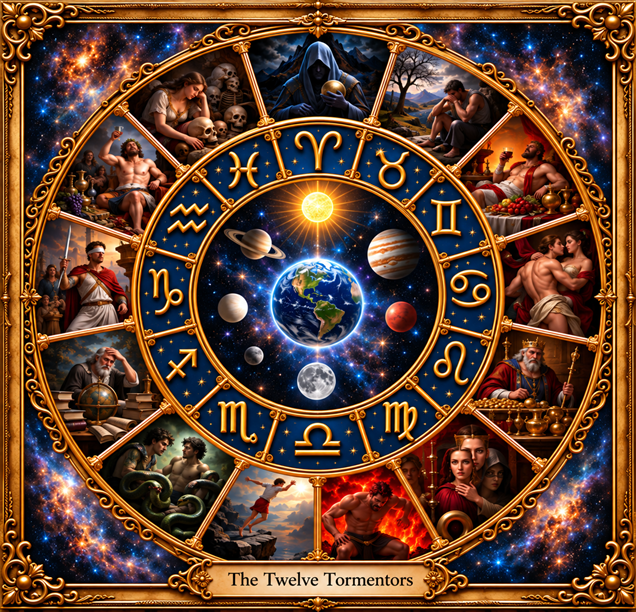
Continuing clockwise around the illustration, we encounter a powerful figure crouched amid a background of raging flames. His muscular body is tense, his fists are clenched, and his expression suggests an overwhelming emotional struggle. The fiery surroundings intensify the impression of a man consumed by an Inner Force that threatens to Overpower his Judgment and Self-Control. The flames are especially significant. Fire possesses the power to warm, Illuminate, Purify, and Sustain Life, but when uncontrolled, it can also destroy everything in its path. In this scene, fire represents the destructive potential of Anger when emotional intensity is no longer governed by reason. The man's clenched fists suggest that his Anger has become more than a passing thought. It has taken possession of his body, affecting his posture, expression, and physical condition. His downward gaze may indicate that the conflict is occurring primarily within himself. Although no adversary is visible, he appears to be suffering under the Force of his Own Emotional reaction. This is an important aspect of the symbolism. Anger does not require an outward act of violence to become destructive. It may disturb the Mind, exhaust the body, and prevent the individual from perceiving circumstances with clarity. The figure therefore represents the Inward Consequences of Emotional turmoil as much as the possibility of outward conflict.
In Corpus Hermeticum XIII, Anger is identified among the Twelve Tormentors associated with the Unregenerated human condition. Within our philosophical interpretation, it represents an influence through which Emotional reactions can obscure Spiritual Awareness and interfere with the exercise of reason. Yet Anger itself is a natural human Emotion. It may arise in response to injustice, betrayal, cruelty, humiliation, frustration, or personal injury. In certain circumstances, anger may even awaken the determination to confront wrongdoing and defend those who have been harmed. The Spiritual problem is therefore not simply the experience of anger, but the surrender of Consciousness to its influence. When Anger becomes the Governing Force of the Mind, the individual may react without considering the consequences of words or actions. Judgment becomes clouded, patience diminishes, and the desire to retaliate may replace the willingness to understand. A disagreement that might otherwise be resolved through thoughtful discussion can become a bitter conflict. Words spoken in a moment of fury may damage relationships that have taken years to establish. Actions committed under the influence of uncontrolled anger may produce consequences that remain long after the emotion itself has subsided. The Fire of Anger may therefore destroy not only what stands before the individual, but also what the individual most deeply values. Relationships, Trust, Peace of Mind, and personal dignity may all be placed at risk when the immediate satisfaction of emotional retaliation becomes more important than Wisdom and Restraint.
There is also a significant distinction between Anger and Malice, another of the Twelve Tormentors. Anger is an Emotional reaction that may arise suddenly and diminish when the circumstances provoking it have passed. Malice involves a more deliberate disposition of Ill Will, in which the individual desires another person's suffering or misfortune. Although Anger may lead to malicious conduct, the two are not identical. A person may experience intense Anger without wishing to harm anyone, just as malice may be concealed beneath an outward appearance of calmness. The figure in the illustration is consequently best understood as representing Anger itself. His posture and expression reveal Emotional turmoil, but the image does not establish a deliberate intention to injure another person. This distinction allows us to recognize the Tormentor without assuming that every person who experiences Anger has become malicious.
Another important aspect of Anger is its relationship with memory and imagination. An individual may repeatedly recall an injury, argument, or humiliation, mentally reliving the experience long after the original event has ended. Each recollection may renew the Emotional reaction, allowing Anger to persist even in the absence of the person or circumstance that first provoked it. The Mind may continually supply fuel to its Own Fire, transforming a temporary Emotional response into a prolonged condition of resentment. Within this Inward struggle, the individual may begin to interpret new experiences through the memory of previous injuries. Words or actions that might otherwise appear harmless may be understood as further offenses, while opportunities for reconciliation may be overlooked. The longer this condition continues, the more difficult it may become to distinguish present reality from the Emotional influence of the past. In this manner, anger can gradually narrow perception and diminish the individual's capacity for understanding.
Within the Hermetic Understanding of Spiritual Regeneration, liberation from Anger involves the restoration of Inner Clarity and Self-Mastery. This does not require the denial of injustice or the suppression of every strong Emotion. Rather, it involves developing the capacity to Recognize Anger without surrendering reason and judgment to it. The Ten Divine Powers provide a broader vision of this Transformation. Self-Control, Knowledge of God, and the Good may all be understood as contributing to a Consciousness no longer governed by destructive Emotional impulses. These connections are philosophical interpretations of the regenerative teaching, rather than a claim that Book XIII assigns one exclusive Divine Power to Anger. The Transformation of Anger into thoughtful action represents an important expression of Spiritual Maturity. The individual may still recognize wrongdoing, oppose injustice, and defend what is right, but does so with Greater Understanding of the Consequences of Personal Actions.
The fiery figure thus represents a Soul caught in the intensity of its own Emotional reaction. The flames surrounding him symbolize the danger of allowing a temporary Emotion to become the Ruling Power of Consciousness. The lesson of Anger is not that the fire of human Emotion must be extinguished, but that it must be brought under the Guidance of Wisdom.
Anger may begin as a reaction
to something outside ourselves,
but its Fire Burns Within Us.