God is ALL in All
This is a Philosophical and Spiritual endeavor to extract, Harmonize, and synthesize the Universal Truths underlying the world's Diverse Religious, Mystical, and Philosophical traditions. Most famously associated with the concept of Perennial Philosophy, it posits that All Major Traditions share a single, transcendent metaphysical Source and Core Set of Truths.
"By the Power of Truth, I, while Living, have Conquered the Universe."
"I Am Nothing, yet I Am Everything."
Plato's Allegory of the Cave
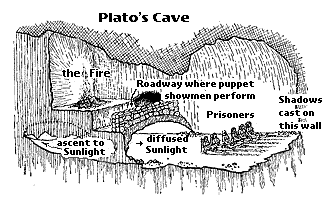
Plato realizes that the general run of humankind can think and speak without any awareness of his realm of Forms. In this allegory, Plato likens people untutored in the Theory of Forms to prisoners chained in a cave, unable to turn their heads to see each other, the cave entrance, or themselves. Behind them burns a fire, and between the fire and the prisoners is a parapet where puppeteers hold up objects that cast shadows on the wall of the cave.
Because the prisoners are unable to see the real objects passing behind them, they mistake appearance for reality. They think the shadows they see on the wall are real, knowing nothing of the real causes of the shadows.
Language and the Forms
If a prisoner sees the shadow of a book and says, "I see a book," he thinks the word "book" refers to the very thing he is looking at. However, he would be mistaken, as he is only looking at a shadow; the real referent of the word is something he cannot see unless he turns his head.
Plato's point is that the general terms of our language are not names of the physical objects that we can see, but rather names of things that we cannot see—things we can only grasp with the mind. Our very ability to think and to speak depends on the Forms, as the language we use gets its meaning by naming the Forms that physical objects participate in. We may acquire concepts by our perceptual experience, but we are mistaken if we think those concepts exist on the same level as the things we perceive.
The Stages of the Allegory
Their Reality: Because the prisoners have never seen anything else, they believe the shadows are the most real things in the world, naming them and playing games to guess which will appear next.
The Escape: A prisoner is freed and forced to turn around to look at the fire and the objects. This is painful and confusing, but they are eventually dragged out of the cave into the sunlight.
The Light and Truth: The light of the Sun initially blinds the freed prisoner, who prefers the familiar shadows. Slowly, their eyes adjust to see reflections, then objects, and finally, they are able to look directly at the Sun. They realize that the Sun is the source of all light, life, and the reality that makes all things visible—a reality far superior to the cave.
The Return: The freed prisoner feels compelled to return to the cave to tell their former companions the truth and free them.
The Reaction: The returning prisoner's eyes are unaccustomed to the darkness, causing him to stumble. The other prisoners mock him, claiming the journey outside ruined his sight. If he tried to unchain them, they would likely react with violence, believing the shadows are the only true reality.
The Philosophical Meaning
The elements of the allegory are highly symbolic, representing different levels of reality and understanding in Plato's philosophy and his Theory of Forms:
The Cave: Represents the Visible World—the world we perceive through our senses, which is full of illusion and changing appearances.
The Prisoners: Represents Humanity, who are largely ignorant and mistake sensory experience for genuine knowledge.
The Chains: Represents the things that bind people to ignorance: unexamined beliefs, cultural conventions, and the reliance on the senses.
The Shadows: Represents Illusion or Mere Belief—the lowest level of understanding. These are not real but are distorted reflections of real objects.
The Objects/Puppets: Represents Physical Objects—the things we perceive daily, which are imperfect copies of the true Forms.
The Fire: Represents the Sun in the visible world—a source of light and understanding that is still artificial and imperfect compared to the true Sun.
The Journey Out: Represents the Philosopher's Quest for Knowledge—the difficult ascent of the soul to the Intelligible Realm through reason and dialectic.
The Sun: Represents the Form of the Good—the ultimate reality, the source of all truth, knowledge, and existence, which illuminates all other Forms.
The Returning Philosopher: Represents the Philosopher-King—the individual who has achieved True Knowledge and is obligated to return to the political world to educate and govern, even if they are rejected.